Chinese textile patterns: reading motifs in context
Compare Chinese textile patterns through documented garments and furnishings, their dates, functions and motif placement.
A textile pattern has a location as well as a subject. A bird enclosed in a small square, a dragon placed inside a central roundel, and flowers repeated along an edge ask different things of the viewer. Begin with the whole cloth: its shape, scale, seams, boundaries, and likely use. Only then move toward the names of individual motifs. This guide compares dated museum objects rather than treating every Chinese textile as part of one unchanging visual code.
The comparisons below distinguish official clothing from furnishings made for overseas customers. They also separate documented object information from a practical method of looking. Historical clothing regulations belong to particular institutions and periods. They do not create present-day prohibitions on wearing birds, dragons, flowers, or particular arrangements. A modern scarf, cushion, or dress needs its own context.
Start with arrangement, before decoding a motif
Look first for a field: the main area within which the pattern develops. Then locate its edges. Does a border close the composition on all four sides, or does the design appear to continue beyond the surviving fragment? A complete framed arrangement invites a different reading from a length of repeat fabric. A photograph cropped tightly around an attractive bird can hide exactly the evidence needed to tell these apart.
Next ask how attention moves. A central medallion may hold the eye while smaller forms lead it outward. A border can provide another sequence, with its own rhythm and orientation. These are descriptions of visible organization, not automatic translations into fortune, power, or marriage. Write down what repeats, what faces another form, and what occupies the corners before assigning any symbolic meaning.
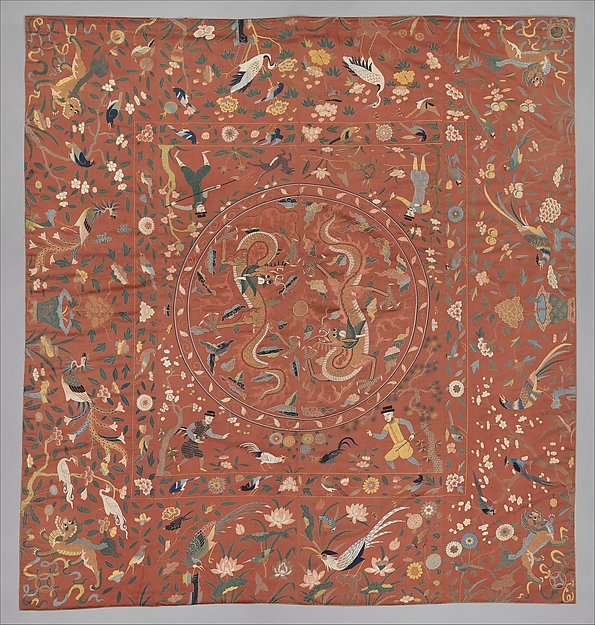
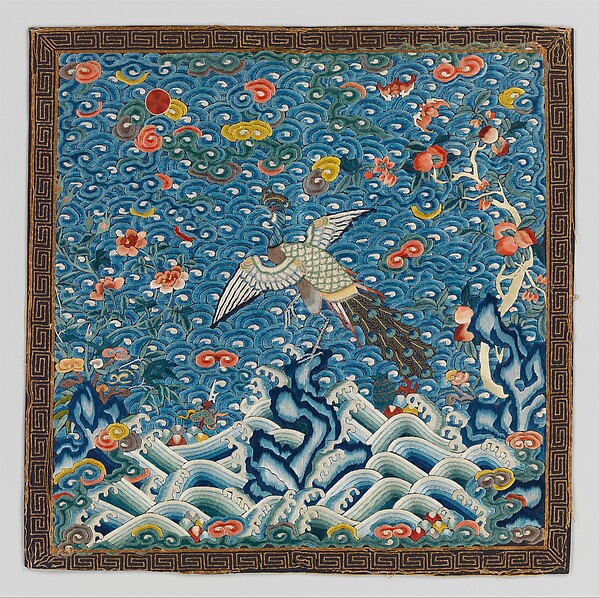
Scale changes the comparison. The Met peacock badge measures roughly 32 centimetres square; its seventeenth-century coverlet exceeds two metres in both directions. The two photographs may occupy the same screen width here, but the textiles would not occupy the same place in a room or on a body. Keeping measurements beside an image prevents a digital layout from flattening that distinction.
Clothing and furnishing are different reading contexts
Use-position means the relationship between an object and the surface that carried it. For a badge, attachment to clothing matters to its public function; for a coverlet, the spread of a furnishing matters to the composition. A detached museum textile does not always preserve its original surroundings. The safest description names what the museum identifies, then states which details of the original setting remain unknown.
Cleveland dates its rank-badge example to 1850–99. Its account explains that paired insignia were attached to the front and back of ceremonial robes, with the front example divided to accommodate an opening. It connects the arrangement of creature and sun with official allegiance. That account supplies a clothing context; it should not be borrowed as a universal explanation for every bird-and-sun textile.
Later export furnishings extend the comparison without proving a single line of development. The Met identifies one silk coverlet, about 1830, as Chinese, probably Canton, for the American market; another, about 1875, as Chinese for the European market. The uncertainty in “probably” matters. These records establish dated examples and intended markets, not the maker’s name, an individual purchaser, or a rule governing every household.
Compare a motif without carrying its rules everywhere
A useful comparison keeps three notes separate: what is visible, what a source identifies, and what you infer. “A bird occupies the centre” describes arrangement. “The museum calls this a rank badge” records an identification. “The composition directs attention to a central figure” is a reading of the design. Combining these into one confident symbolic statement would conceal the steps that make the conclusion assessable.
For your own design research, sketch the arrangement in simple shapes before copying details. Mark the centre, border, corners, and direction of repeated units. Add the historical function and date next to the sketch. This exercise helps preserve the distinction between studying an arrangement and claiming the authority of the original object. It also makes comparisons possible when the motifs themselves differ.
Avoid turning a museum example into a modern etiquette test. The official meaning of a historical badge does not establish that a contemporary wearer is claiming an office. Equally, an export furnishing is not evidence that every unfamiliar combination is an error. Ask who commissioned, made, used, and later classified a textile, and leave unanswered questions visible when the record cannot resolve them.
A bird within an official square
China · Qing dynasty · late 18th–early 19th century
- Historical function
- Rank badge; clothing insignia
- Placement to examine
- Compare the bounded square with its historical attachment to ceremonial clothing.
The Met identifies this embroidered object as a peacock rank badge. Its compact square format gives the central bird a defined arena. Read the outline and the surrounding forms together, rather than extracting the peacock as a free-standing emblem. The museum record provides the material, date range, dimensions, and acquisition credit; it does not identify the person who wore this particular piece.
As a viewing exercise, follow the bird’s silhouette before examining the smaller details. Ask how its body fits within the frame and how the surrounding pattern balances the central form. Return to the complete square after looking closely. These questions concern the pictured arrangement and do not require assigning a precise rank or a personal biography that this record does not supply.
A centre and borders for a furnishing
Chinese, for European market · 17th century
- Historical function
- Coverlet; export furnishing
- Placement to examine
- A large textile organized around a central roundel and enclosing borders.
The Met’s curator describes a dragon roundel, four figures in European dress, and borders containing birds and flowers. The record compares the centre-and-border structure with Chinese kang covers while identifying this object as export work. Its commentary discusses unusual combinations and possible client involvement, rather than documenting a named commissioner. That qualification is essential when discussing the arrangement.
Try reading the photograph from the outer edge inward, then reverse the route. Notice whether the border feels like a continuous frame or a sequence of separate scenes. Compare that experience with the compact badge above. This is a practical comparison of two layouts; it does not establish that the objects shared a ceremony, a user, or a single intended meaning.