
Chinese plant patterns: reading combinations in context
Read plant motifs together through dated museum objects, their placement and documented interpretations, without treating every flower as a fixed code.
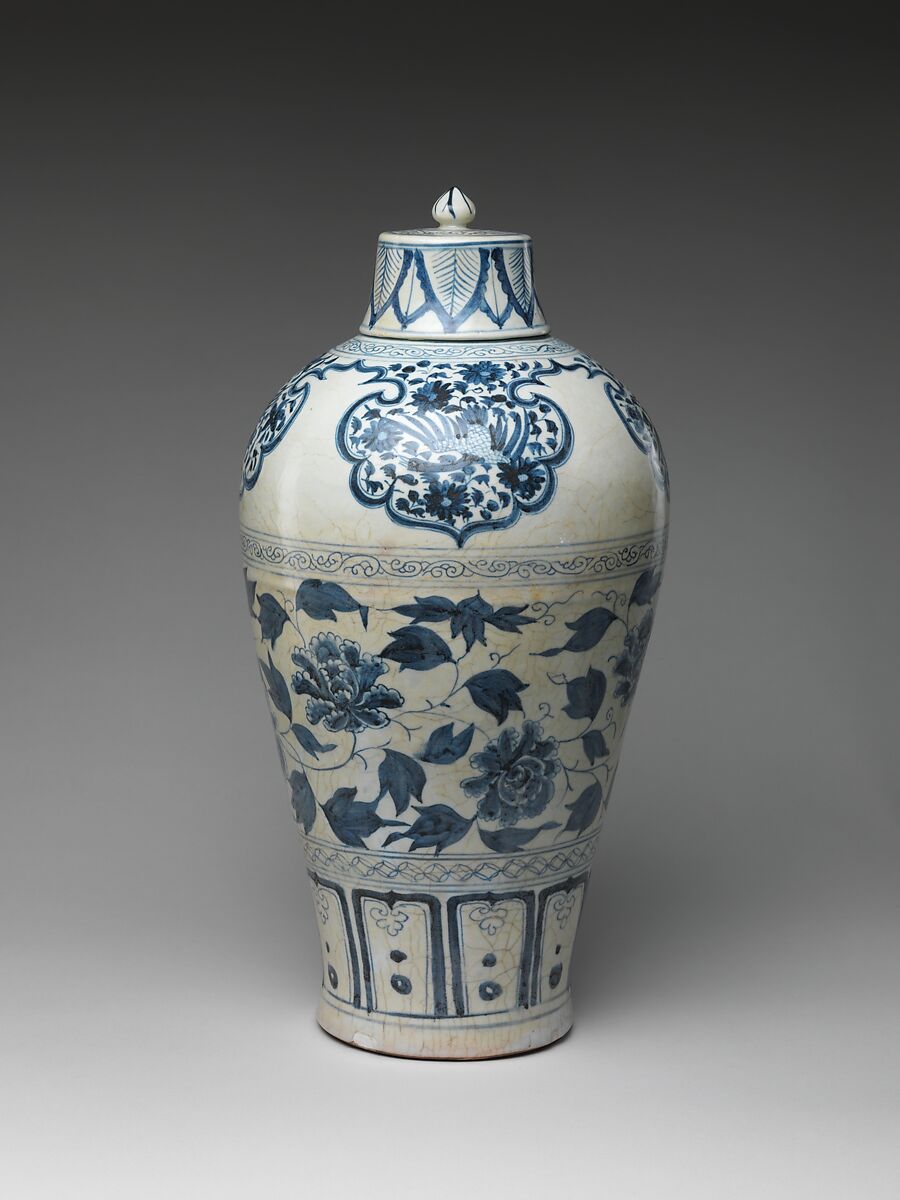
Bottle with Peony Scroll, China, mid-fourteenth century; porcelain painted in cobalt blue under transparent glaze. The Metropolitan Museum of Art, 26.271.1a,b. Complete museum photograph, Public Domain / CC0.
The Metropolitan Museum of Art, Rogers Fund, 1926; 26.271.1a,b · CC0 · Original museum JPEG retained without cropping, recolouring or resampling.
Chinese plant patterns: seasons, combinations, and context
A flower changes when it joins another flower, a tree, an inscription, or a border. That does not mean every pairing has a fixed translation. Start by asking what actually shares the surface: plants intertwined in one scene, flowers separated into compartments, or a repeated motif above a second band. The relationship between forms is part of the evidence. A list of names alone leaves out the arrangement that makes a particular object worth studying.
This guide follows Chinese examples and one Japanese comparison with an identified Chinese plant grouping. Museum descriptions provide the dates, plant identifications, and historical interpretations. The looking exercises are our observations and questions. Keep those two kinds of statements distinct: a museum attribution can support a named subject, while an arrangement can be described without claiming to recover everything its maker or first owner intended.
Looking method
Read the relationship before adding meanings
First make a simple map. Draw the outline of the object and mark where each plant appears. On a vessel, distinguish the shoulder, body, and foot; on a painting, distinguish adjacent sections from a continuous landscape. Ask whether stems touch, whether flowers share a ground, and whether framing lines separate them. These observations let you explain what “together” means for this particular work.
Next record your confidence in identification. A blossom without its leaves may be difficult to name from a small photograph. A stylized petal panel can look very different from a living flower. Use the museum’s wording when it supplies an identification, and avoid upgrading a resemblance into certainty. If only one side of a vessel is illustrated, say so. The unseen surface may contain the other half of the subject.
Then ask what kind of combination you have. A named grouping, a sequence of seasonal flowers, and two motifs divided between ornamental bands are different arrangements. A shared surface is evidence of coexistence; it is not sufficient evidence for a new combined blessing. Read any inscription and object description before attempting a verbal interpretation. When those sources are silent, a precise account of placement remains useful.
Documented grouping
Pine, bamboo, and plum: the Three Friends of Winter
Philadelphia’s early-fifteenth-century lacquer box provides a Chinese example of the named trio. Its museum description identifies plum, bamboo, and stylized pine intertwined across different planes. The museum relates their ability to flourish through winter to integrity and fortitude associated with the scholar-gentleman. This supports a historical reading of that design, rather than a promise that possessing the image produces those qualities.
For a close comparison, sketch the three plants with different kinds of lines. Mark broad trunks, fine branches, clusters of needles, and leaves only where you can identify them. See whether one plant provides a framework through which the others pass. The exercise helps distinguish three recognizable plants from three isolated emblems. It also reveals why a description of intertwined growth communicates more than a row of symbolic keywords.
Philadelphia Museum of Art: Box with the Three Friends of Winter
Seasons in one composition
Different flowering seasons can share a painting
In Xu Wei’s sixteenth-century Sixteen Flowers, Philadelphia’s account identifies plants associated with different seasons shown in bloom together. It places peony and hydrangea with spring, lotus among the summer flowers, chrysanthemum and hibiscus with autumn, and plum among the winter flowers. The accompanying poem, the museum explains, evokes a practitioner able to bring flowers into bloom out of season. The combination therefore has a literary setting as well as a seasonal one.
This example gives you a useful question for other works: is the image describing one moment, or gathering subjects from several moments? Do not assume a mixed flower scene records a garden on a particular day. A painted surface can place things next to one another that are separated in lived time. A title, inscription, or museum account may explain why; an unidentified image may leave the question open.
Use season words as an aid to comparison, keeping the source beside them. The museum’s account of this painting is not a planting calendar for every climate or a universal schedule for every flower variety. Nor does an association with winter require snow to be painted behind a branch. Look for the relationship between the seasonal subjects and the rest of the composition before treating season as the work’s only organizing idea.
Motifs on a vessel
Lotus and peony can occupy different ornamental zones
The Met’s Bottle with Peony Scroll combines scrolling peonies on the body with stylized lotus petals at the base. Its account discusses the design through connections between China and other regions: the lotus treatment relates to Indo-Himalayan imagery, while the neck patterns invite comparison with textile cloud collars. This interpretation attends to the parts of the surface and their different histories. It does not give the two plants a single combined slogan.
A second Chinese example, the early-fourteenth-century meiping in Saint Louis, is explicitly titled with both peony and lotus scrolls. The museum describes their distribution in horizontal sections and identifies the material as Jingdezhen porcelain with underglaze cobalt decoration. Compare that description with the Met bottle: a scroll and a band of stylized petals are not interchangeable merely because both contain lotus imagery.
For your own viewing notes, follow one continuous stem before switching to the next zone. Check where the design stops, where a framing line intervenes, and where another kind of ornament begins. Write separate sentences for subject and arrangement. “Peonies circle the main body” and “petal panels rise from the foot” preserve information that disappears when the whole surface is called simply a floral pattern.
The Met: Bottle with Peony Scroll
Saint Louis Art Museum: Prunus Vase with Peony and Lotus Scrolls
Use the evidence
Carry the context into the comparison
When comparing a painting with a ceramic or textile, retain the object type in your notes. A plant can travel between materials while changing its scale, position, or relationship to the viewer. A vessel must be turned to reveal its circumference; a painting may be viewed as an extended sequence. A photograph can make both appear to be flat rectangles. Returning to the object’s shape prevents that screen effect from becoming a mistaken historical conclusion.
A practical record needs only four parts: object and date, identified plants, visible arrangement, and the source’s interpretation if one is supplied. Leave room for a fifth note recording uncertainty. You might know the plant names without knowing why they were chosen; you might know that a trio is named while seeing only one of its members in the available view. Both are legitimate results of careful looking.
These historical examples offer ways to study design. They do not establish modern rules about which flowers people may combine, wear, give, or display. For a present-day arrangement, identify the intended setting and the people involved. For an older object, identify the evidence. In either case, a familiar plant association is a starting point for inquiry, and the complete composition gives it its particular setting.
Object comparison
One view cannot show an entire plant grouping
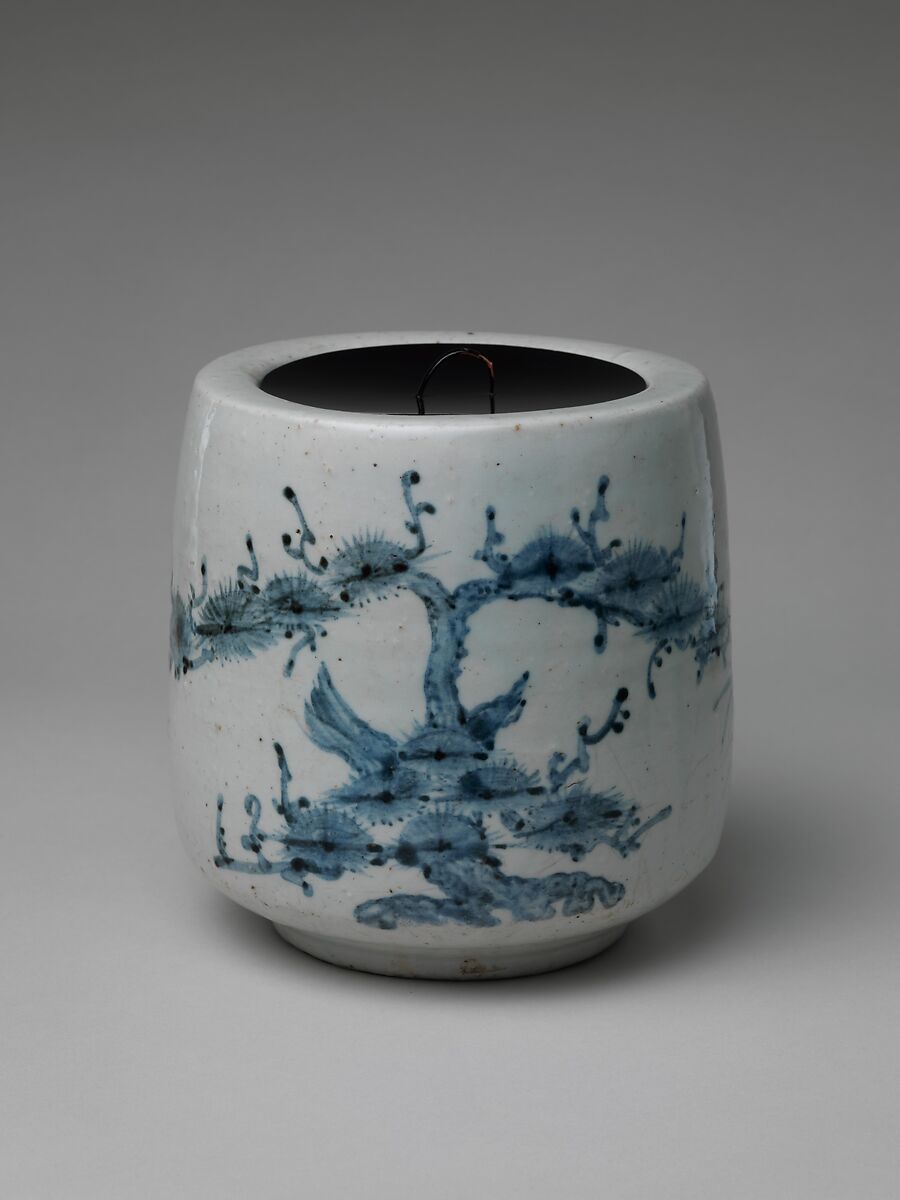
This Japanese tea-gathering jar is a comparison, not a Chinese object. The Met identifies the full design as the Three Friends of Winter and interprets it through longevity and renewal. Its title locates pine on the front and plum with bamboo on the reverse. The photograph reproduced here shows the pine-facing side; it cannot by itself demonstrate all three plants.
As a visible observation, the trunk rises toward an uneven spread of dark needle clusters, leaving pale areas between branches. Imagine turning the cylinder, then consult the museum’s additional views. This simple distinction between the object’s complete decoration and one photograph is essential when a named combination appears to be missing a member.
Object comparison
Follow the bands from shoulder to foot
In the photograph, thin horizontal borders separate the large flowering scroll from the petal-shaped panels below it. Look at the difference in scale and spacing before looking for a shared message. The image supports an account of adjacent ornamental zones. The museum record supplies the peony and lotus identifications and the wider discussion of cultural connections.
Read individual plants in context
- Plum blossom: seasonal and literary settings
- Bamboo: brushwork and plant groupings
- Lotus: religious, literary, and seasonal contexts
- Peony: interpreting a flower in context
Sources and image credit
- Philadelphia Museum of Art: Box with the Three Friends of Winter
- Philadelphia Museum of Art: Xu Wei, Sixteen Flowers
- The Met: Bottle with Peony Scroll
- Saint Louis Art Museum: Prunus Vase with Peony and Lotus Scrolls
- The Met: Freshwater Jar with Pine and Plum with Bamboo
- The Met: Open Access image policy (CC0)
Both photographs are reproduced without cropping or alteration from The Met’s Public Domain Open Access images, released under CC0.