
Chinese ceramic patterns: reading motifs on objects
Read Chinese ceramic patterns through dated museum objects, full views and details, keeping placement, combinations and attributed meanings together.
Reading ceramic patterns: peaches, bats, and the space between them
A peach on porcelain can invite a symbolic reading, but a dish gives us more to consider than a list of meanings. Where does the fruit sit? What accompanies it? Does the design fill the centre, follow the rim, or continue beyond the visible face? This example offers a way to read a particular object before extending an interpretation to other ceramics.
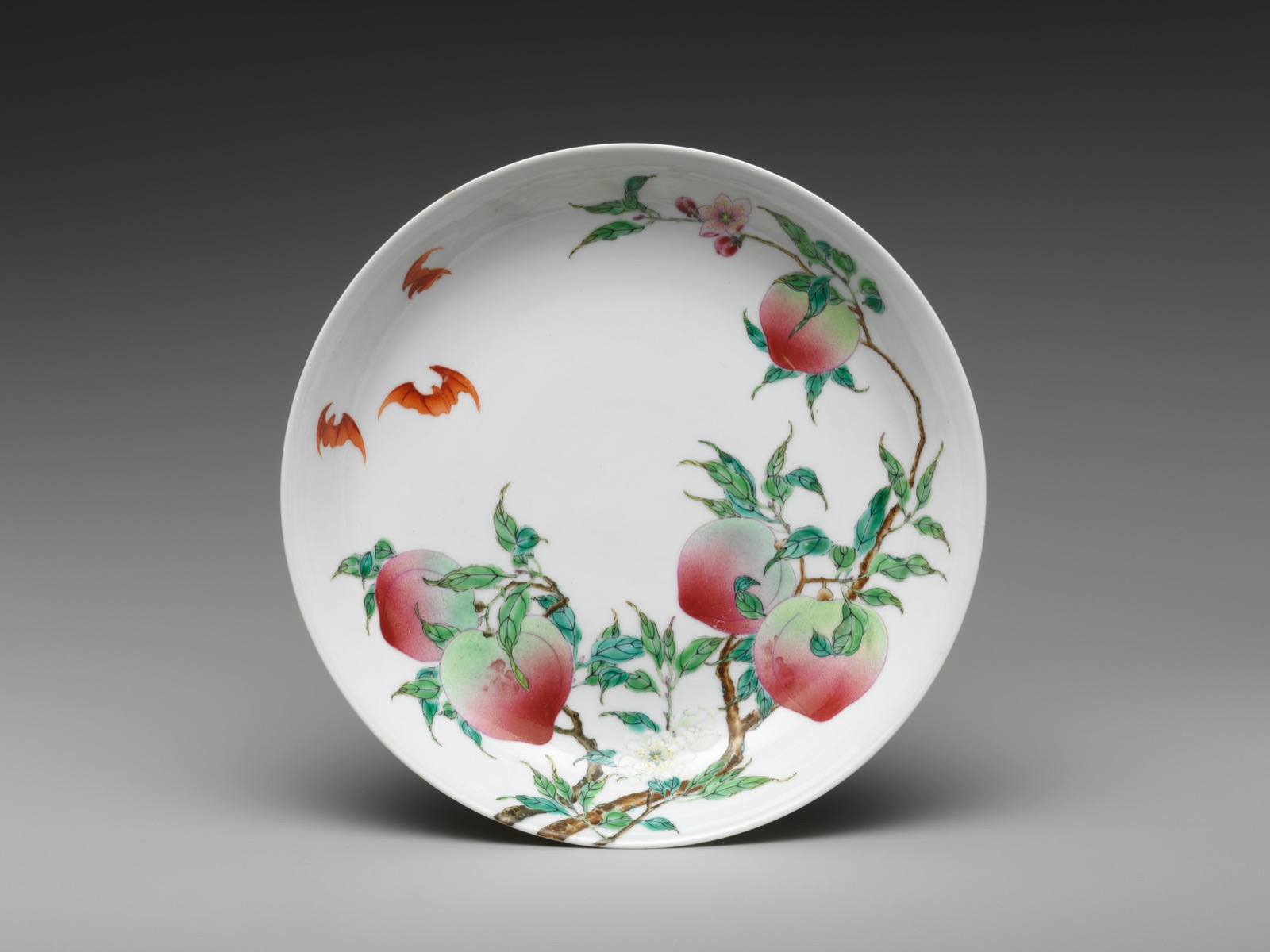
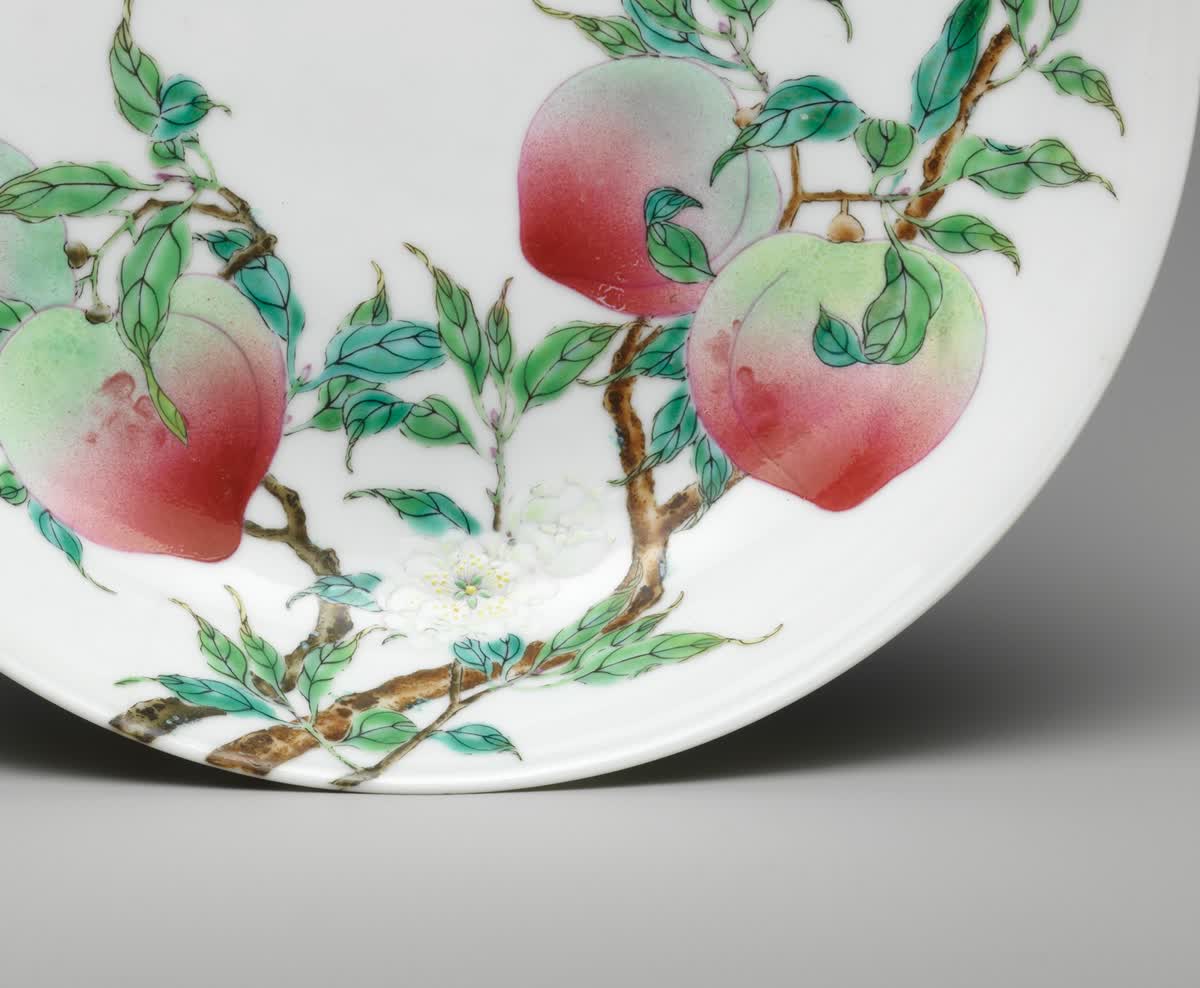
Keep the complete photograph beside the detail. The first preserves the relationship between the decoration and the circular vessel; the second makes smaller painted decisions easier to inspect. Both show the same dish, rather than two examples from different periods. The enlargement below is a crop of the museum photograph, so it supplies a closer view without adding another angle or revealing the underside.
Dish with peaches and bats
China, early 18th century; Qing dynasty, Yongzheng period (1723–35)
Porcelain painted in overglaze polychrome enamels (Jingdezhen ware) · 1997.1.11
The Metropolitan Museum of Art. Gift of Stanley Herzman, in memory of Gladys Herzman, 1997.
Museum record
What the museum establishes
The Met identifies this as Jingdezhen porcelain with overglaze polychrome enamels, dated to the early eighteenth century and assigned to the Yongzheng period. Its accession number is 1997.1.11. The listed overall diameter is about 20.7 centimetres. Keep that scale in mind: the large image on a screen can make the painted fruit seem much larger than it is on the vessel.
The museum explains the pink as a technical achievement. A process introduced through Europe used gold nanoparticles to produce the colour; the record says enamel was sprayed here to suggest ripening peaches. That account connects a visible effect to a particular material technique. The object record does not identify a named recipient, birthday celebration, or original meal for this dish. Its decoration alone cannot supply those missing details.
The Metropolitan Museum of Art — Dish with peaches and bats, 1997.1.11
Editorial close looking
Start with the whole dish
Look first at the white interval in the middle. The painted elements gather around it without making an even ring. The lower half carries a dense tangle of branches, leaves, blossoms, and fruit; the upper left holds smaller, separated flying forms. Following those two areas with your eye gives a more accurate account of the composition than saying that the plate has a floral border. The decoration is unevenly weighted, and that imbalance is part of what makes it easy to follow.
In this photograph, five peaches are visible on the interior. One sits high on the right; the others cluster below. Three orange-red bats appear to the left. These are counts from the displayed view, not a claim about every surface of the object. A dish has an exterior and a base as well as an interior. Before giving a total for an entire vessel, inspect documented views of those other surfaces too. A familiar symbolic number should never be used to fill a gap in a photograph.
Trace the brown branch from the lower edge towards the right-hand fruit. Smaller stems and leaves turn away from that route. The line provides a connection between fruit separated by considerable white space, while the bats occupy another region without touching the foliage. The two motif groups therefore share a field without becoming one continuous drawing. Cover the bats briefly, then uncover them: the balance of the open upper area changes even though the fruit remains in exactly the same place.
Editorial close looking
Use the detail to test a first impression
The enlarged lower section lets you distinguish the broad pink and pale green areas of fruit from the narrower outlines of leaves. Some leaf tips overlap the peaches. White blossoms sit close to the brown stems and can recede into the white ground when the photograph is small. The enlargement helps recover them. This matters because a quick glance at a thumbnail might reduce the image to fruit alone, overlooking the flowering growth that accompanies it.
Compare one peach with a neighbouring leaf. The fruit has a gradual change of colour across a broad rounded surface, whereas the leaf has a pointed outline and more explicit internal lines. Those different treatments produce different visual textures within a single painted design. The museum’s explanation of sprayed pink enamel helps account for the fruit’s soft colour transition, but the crop itself cannot identify a chemical ingredient. Technique comes from the record; the visible transition is something we can inspect.
Return to the full image after looking at the crop. In isolation, the branch can look like a botanical specimen; on the dish it follows the lower curve and rises into the right side. The rim gives that movement its setting. A detail is useful precisely because you can move back out from it. If only the cropped image survives in a presentation, include the accession number and an explicit crop label so another reader can recover the original composition.
Museum comparison and interpretation
Read the peach and bat together
The Walters Art Museum explains the pairing on its own Dish with Peaches and Bats, accession 49.1238, dated 1736–1795. Its account links peaches with longevity through the legend of the Queen Mother of the West’s garden. It connects bats with happiness through the resemblance in sound between the Chinese words. These explanations support an auspicious reading of the combination. They do not establish the personal circumstances in which the Met dish was commissioned or used.
That comparative record also describes five peaches along a branch and three bats on the opposite side. Shared subjects and a related arrangement make it a useful comparison, while the separate accession numbers and dates keep the two objects distinct. The Walters dish cannot serve as an alternate photograph of the Met example. When comparing ceramics, carry the collection identifier with each image; similar titles are particularly easy to confuse.
For this dish, a careful interpretation can therefore combine a source-backed symbolic association with an observed arrangement: peaches and bats offer complementary wishes, and the painter places their groups across an open centre. Calling that open area a deliberate stage for a birthday dedication would go further than the records allow. You can describe how a design communicates without assigning a specific event to an object whose original occasion is undocumented.
The Walters Art Museum — Dish with Peaches and Bats, 49.1238
Looking practice
Carry the method to another ceramic
Begin a new looking note with the vessel rather than the symbol: shallow dish, tall vase, covered box, or another documented form. Mark which surface the image shows. Sketch the largest empty area and the direction of the main branch, animal, or repeated band. Only then write down the identifiable motifs. This order helps preserve the way decoration occupies an object instead of turning the object into a loose collection of emblems.
Next separate three kinds of statement in your note. Copy the museum’s attribution and material with its date range intact. Describe a visible feature in your own words, including which photograph supports it. Finally add an interpretation with a named source and an appropriate limit. For example, a record-backed longevity association can be useful without implying that every peach-decorated vessel had an identical purpose or audience.
Finish by checking what the photograph leaves unanswered. An unseen base cannot confirm a reign mark, and a close view of paint cannot authenticate a ceramic. Record those limits briefly, then keep looking at the evidence you do have: the relative size of the motifs, their distance from the rim, the relationships between colours, and the way a branch links separate areas. Those concrete observations make a comparison reusable when you encounter another object with the same subjects arranged differently.
Sources and image credit
- The Metropolitan Museum of Art — Dish with peaches and bats, 1997.1.11
- The Walters Art Museum — Dish with Peaches and Bats, 49.1238
- The Met — Open Access image policy (CC0)
Both images reproduce the same museum photograph, published as Public Domain through The Met’s CC0 Open Access programme. The second is an editorial crop.