
Chinese animal patterns: reading objects in context
Compare animal motifs on documented objects through dates, placement and use, keeping visible features separate from attributed meanings.
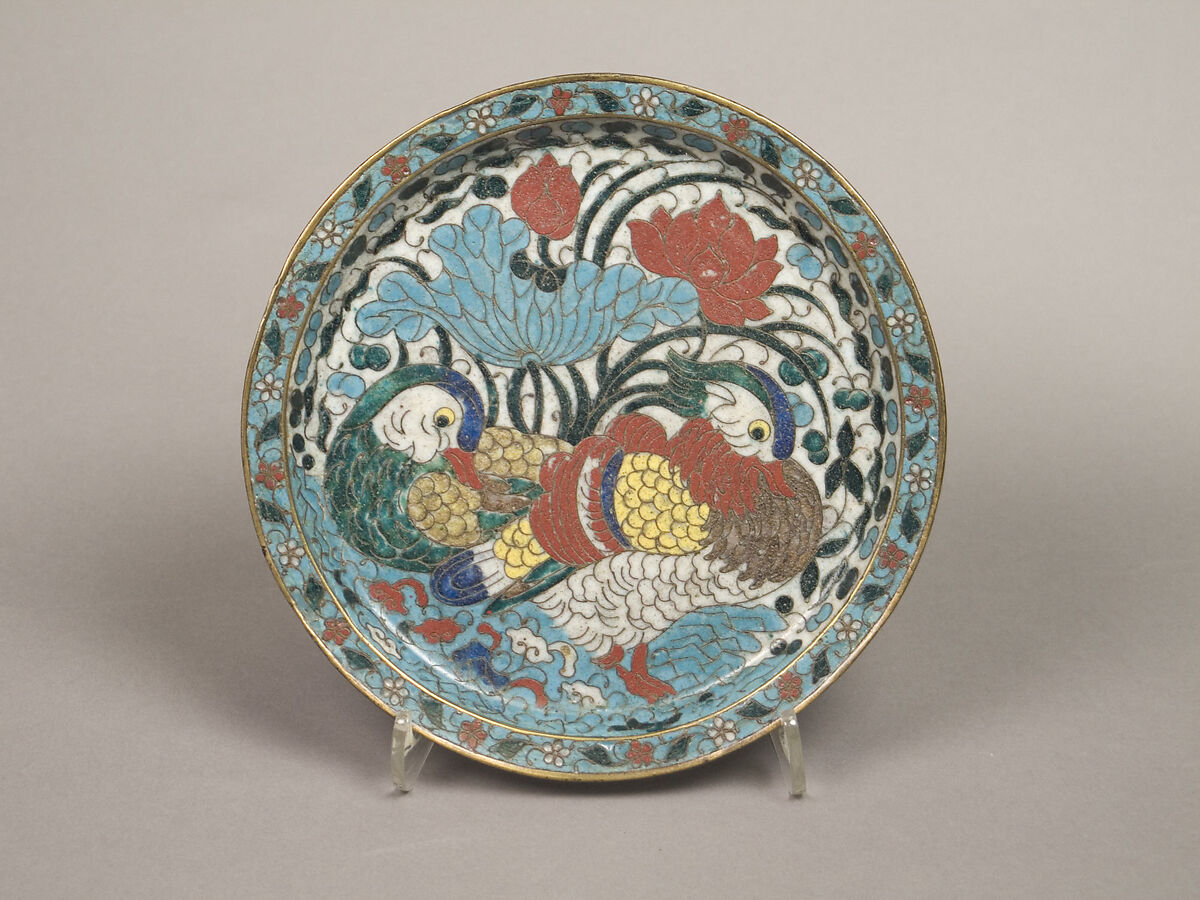
Dish with mandarin ducks and lotuses, China, late fifteenth–early sixteenth century; cloisonné enamel. The Metropolitan Museum of Art, 2011.111. Complete museum photograph, Public Domain / CC0.
The Metropolitan Museum of Art, Purchase, The Vincent Astor Foundation Gift, 2011; 2011.111 · CC0 · Original museum JPEG retained without cropping, recolouring or resampling.
Animal companions: reading pairs, plants, and numbers in context
An animal motif changes when it has company. A bird beside another bird, a bat near a peach, or a creature surrounded by flowers creates relationships that a one-word symbol label cannot capture. Start with those relationships: which forms touch, which face each other, and which share a branch, bank, or vessel? This guide follows two museum objects closely before considering a documented group of five bats.
The photographs below show different works, rather than alternate views of a single object. One is a small enamel dish; the other is a hanging scroll. Both include mandarin ducks, but they give the birds different amounts of space and different companions. Museum explanations are identified separately from our observations of the photographs. That separation lets a symbolic reading remain useful without turning every visible pair or repeated mark into a promise of good fortune.
Object record and close looking
A pair within a circular field
China, Dish with mandarin ducks and lotuses, late 15th–early 16th century. Cloisonné enamel; diameter 16.5 cm. The Metropolitan Museum of Art, 2011.111. Purchase, The Vincent Astor Foundation Gift, 2011.
The Met dates this Chinese dish to the late fifteenth or early sixteenth century and identifies its material as cloisonné enamel. Its catalogue connects mandarin ducks with marital fidelity and explains their combination with lotus flowers as a wish for harmony between spouses. The account presents the idea that the birds mate for life as a traditional belief underlying the imagery. Read it as a cultural explanation, rather than a biological description of every duck.
In the photograph, the two large birds occupy much of the lower interior. Their rounded bodies overlap a crowded field of leaves, stems, flowers, and blue wave-like shapes. The heads turn into the shared space between them. Above, broad blue leaves and red blossoms expand towards the rim. These are observations of the displayed face. They describe how the painterly design has been fitted into a circle; they do not identify an original owner or wedding.
Follow the narrow metal outlines around a leaf and then around a bird’s feathers. The coloured areas are separated into many small compartments. From farther away the birds read as two substantial forms; closer up, their bodies divide into scales, curves, and bands. That change of viewing distance matters. A thumbnail may preserve the pair but lose the visual connections between birds and plants. Looking only for an auspicious emblem would miss much of the object’s surface.
Notice also how little open ground remains. The floral band at the edge frames an interior already dense with ornament. The lotus is not an isolated botanical illustration beside an isolated animal. Its stems and large leaves help fill the same bounded field. The museum’s interpretation makes the combination meaningful, while the photograph shows how closely the companion subjects have been brought together. Keep those two kinds of evidence alongside one another.
Object record and close looking
The same companions in a taller landscape
Lü Ji, Mandarin ducks and cotton rose hibiscus, China, late 15th century. Hanging scroll; ink and colour on silk. Image 172.7 × 99.1 cm. The Metropolitan Museum of Art, 2005.494.2. Ex coll.: C. C. Wang Family, Gift of Oscar L. Tang Family, 2005.
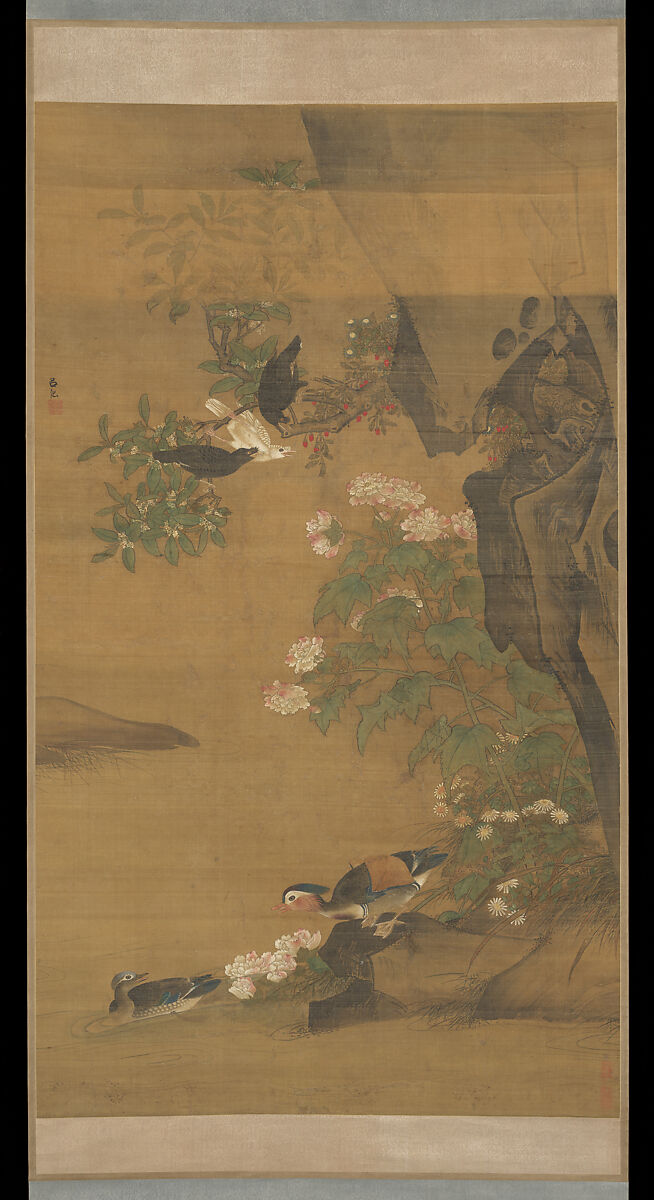
The Met attributes this late-fifteenth-century silk hanging scroll to Lü Ji. Its commentary reads the foreground mandarin ducks as a wish for a happy marriage. It also explains that hibiscus and cassia participate in a Chinese verbal rebus expressing prosperity and honour for a married couple. That interpretation depends on named plants and language. Two birds by themselves would not establish the complete phrase.
Look at the lower part of the photograph first. One duck is on the water towards the left; another stands higher beside the bank. Unlike the dish’s compact pairing, the birds occupy different levels. A flowering branch extends between their areas, and the bank slopes up into the right-hand vegetation. Calling them a pair remains useful, but it should not make us overlook their different positions and postures. A symbolic relationship does not require a mirror image.
Now let your eye travel upwards. Pink flowers rise above the foreground, while branches and other birds appear higher in the composition. The relatively open left side allows that rising movement to remain legible. Compare this with the dish’s tightly filled interior. Both works bring birds into a plant-filled setting, but one compresses its subjects within a circle and the other distributes them across a tall hanging format.
The other birds are a useful check on counting. A statement that the painting contains only two birds would confuse the foreground motif with the entire scene. Specify what you counted: the foreground ducks, the birds visible in a detail, or every identifiable bird in a complete photograph. Likewise, a plant near a duck need not automatically belong to the same rebus. Where a museum names a specific combination, preserve that attribution instead of extending the explanation to every surrounding flower.
The Met — Lü Ji, Mandarin ducks and cotton rose hibiscus, 2005.494.2
Museum comparison
When five is documented, and when a count is only a count
The Baur Foundation offers a clear example in its porcelain bowl CB.CC.1934.532, dated to the Yongzheng reign, 1723–1735. The museum describes five copper-red bats on the exterior beneath a celadon glaze and explicitly connects the group with five blessings: longevity, health, wealth, virtue, and a natural death. Here the interpretation is attached to a named object and a recorded count. The bowl is a textual comparison here; neither photograph above shows it.
That example gives us a reason to investigate a group of five bats; it does not make every group of five animals the same message. First identify the species, the accompanying motifs, and the part of the object under discussion. Five decorative birds on a border might be a visible repetition without a documented numerical explanation. An odd number may help fill a surface, distribute weight, or continue a band. Where a record gives no interpretation, describe the arrangement and leave the symbolic question open.
Curved objects introduce another problem: one photograph may show only part of a design. The front of a bowl cannot reliably establish an exterior total. Nor should an expected number supply an unseen animal. If a catalogue reports a total that you cannot see, write that the catalogue records it. If you count from a photograph, qualify the count by that view. This small distinction makes a comparison much easier for another reader to check.
Looking practice
Build a reading that someone else can check
Begin with the object label: title, date range, material, collection, and accession number. Then make a short visual inventory without assigning meanings. Note a pair of birds at the bottom, a flowering stem above, a crowded rim, or an open stretch of water. Describe orientation as well as quantity. Animals that look towards each other can create a different visual relationship from animals moving in a procession, even when the count is identical.
Next add the museum’s explanation in a separate sentence and keep its scope intact. An interpretation of mandarin ducks and lotus on one dish is stronger evidence for that particular combination than for an unidentified bird on an unrelated object. A recorded verbal pun also needs the correct language and the right companion subject. Similar-looking flowers, uncertain species, and partial views are reasons to slow down and compare the record, rather than force an attractive phrase onto the design.
Finally return to the whole image. Ask whether your note still describes the object someone else can see. Does it preserve the vessel’s shape or the scroll’s vertical movement? Does it distinguish the two foreground ducks from additional birds? Does it identify the museum photograph and any crop? A careful reading can acknowledge an auspicious association while remaining grounded in placement, material, and the specific evidence that supports it.
Continue looking
Sources and image credits
- The Met — Dish with mandarin ducks and lotuses, 2011.111
- The Met — Lü Ji, Mandarin ducks and cotton rose hibiscus, 2005.494.2
- Baur Foundation — Bowl with bats, CB.CC.1934.532
- The Met — Open Access and CC0
Both photographs are published as Public Domain by The Metropolitan Museum of Art under its CC0 Open Access programme. They show two different objects and retain the supplied compositions.