
Spring Festival (Chinese New Year) dates, 2026–2036
Calendar rule: The first day of regular lunar month 1. All dates below are Gregorian; lunar festivals use regular months, not repeated leap months.
This guide discusses Chinese Spring Festival traditions. Other Lunar New Year observances have their own names and practices. New Year’s Eve is the preceding day; a celebration season is longer than the first day.
| Year | Gregorian date | Check the source |
|---|---|---|
| 2026 | HKO 2026 table | |
| 2027 | HKO 2027 table | |
| 2028 | HKO 2028 table | |
| 2029 | HKO 2029 table | |
| 2030 | HKO 2030 table | |
| 2031 | HKO 2031 table | |
| 2032 | HKO 2032 table | |
| 2033 | HKO 2033 table | |
| 2034 | HKO 2034 table | |
| 2035 | HKO 2035 table | |
| 2036 | HKO 2036 table |
Date evidence: 2027–2036 compared with Hong Kong Observatory tables on October 19, 2026; the 2026 table was content-checked on October 22, 2026 (UTC). This is a fixed reference window, not a live claim about today’s year.
Human review of this date section is pending. AI-assisted date explanations added separately from the guide’s existing review history.
Confirm official days off, venue access and the organizer’s date separately. Use the calendar for another year, or compare eight observances across the next ten years.
A calendar tied to moon and seasons
The Chinese calendar is lunisolar: it relates months to the moon while keeping the year connected to the solar seasons. This is why the festival moves on the Gregorian calendar rather than falling on January 1.
Evidence note
Claim. Chinese Spring Festival follows a lunisolar calendar, so its Gregorian date moves rather than remaining on January 1.
What supports it. The Smithsonian sources place Spring Festival within a seasonal and lunar-calendar framework and document lived celebrations.
What it cannot prove. They do not make one Chinese family example representative of every Lunar New Year celebration or every culture using a lunisolar calendar.
In the Chinese festival cycle, New Year’s Eve leads into celebrations traditionally continuing to the Lantern Festival on the fifteenth day of the first month. This cultural span does not mean everyone has fifteen days away from work or follows the same daily schedule.
Reunion takes different forms
A reunion meal and visits to relatives make the holiday a time for renewing relationships. The dishes, rituals, and people at the table differ. Some families make offerings to ancestors; others mark the occasion primarily through a meal and greetings.
In a Smithsonian personal essay, Wendy Wang describes celebrations changing as her family moved from Taipei to the United States. Her mother’s hot pot became one way to keep the holiday present. A changed menu can carry continuity rather than signal its loss.
Joining a celebration
If invited, ask your host what would be useful to bring and which greetings their family uses. Follow their lead on food, gifts, and any religious observance. Public celebrations can be a welcoming first encounter, while a family gathering may have its own expectations.
Avoid making one custom a test of whether someone celebrates correctly. Work, distance, religion, and personal preference all affect participation. Curiosity about what the occasion means to your host will usually tell you more than a checklist.
Red decorations, written wishes and public performances
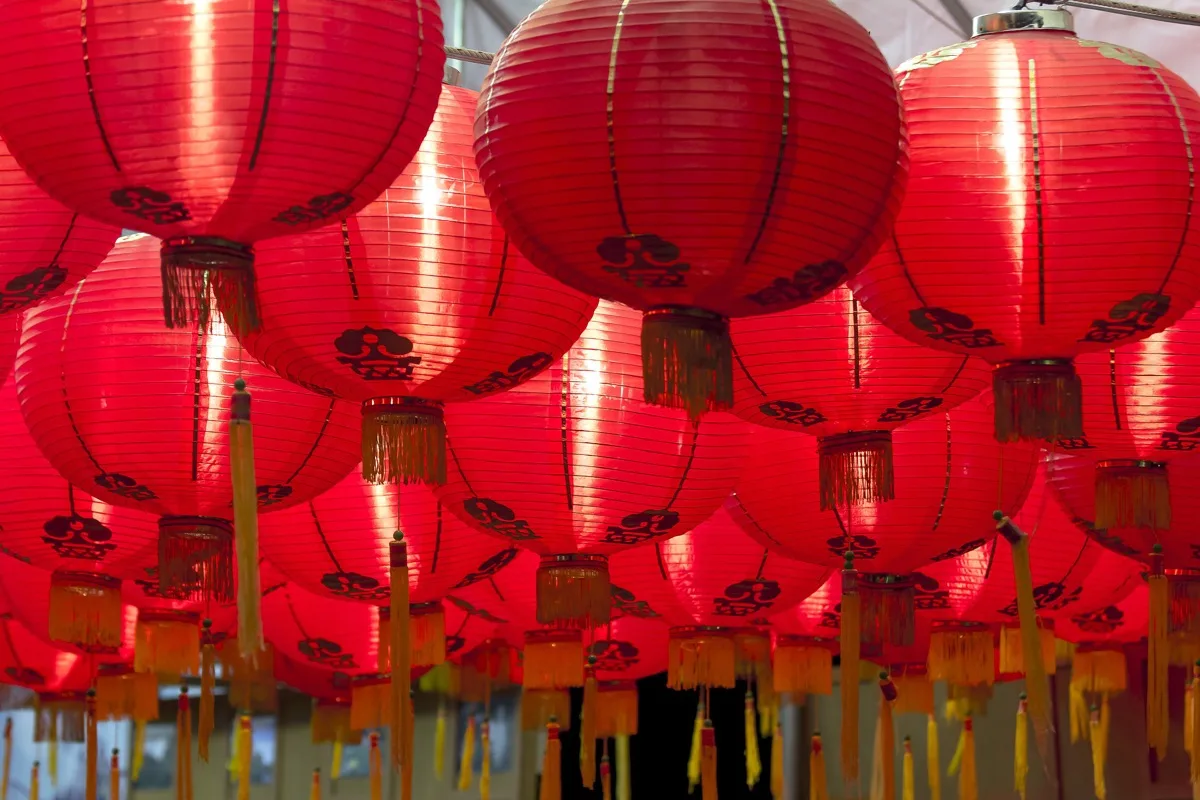
A red lantern, a paper 福, a red envelope and a wedding double-happiness sign are not interchangeable simply because they share a color. New Year displays bring together written wishes and familiar decorative forms. Read the actual character and occasion before assigning a meaning; the linked Fu and red-envelope articles explain their particular contexts.
A public Spring Festival programme can include performances and displays chosen by its organiser, while a household gathering may have a different focus. Singapore Chinese Cultural Centre’s teaching material describes Singapore’s lion-dance and Chingay contexts as located examples. A performance programme has its own date, venue and participants; it is not a template that every family or every Chinese community must follow.
A useful distinction
Lunar New Year is not interchangeable with one set of Chinese customs, and not everyone of Chinese or East Asian heritage celebrates it.
Choose a greeting for the person and the occasion
For family or close friends who celebrate, “Happy Lunar New Year! It is lovely to spend the evening with you” can be warm without assuming a particular meal or ritual. Use the name your host uses for the occasion. The Smithsonian personal account cited here shows one family adapting its celebration between Taipei and the United States; it does not prescribe a greeting for every family.
For a colleague who has mentioned celebrating, “Wishing you a happy Lunar New Year and a good year ahead” keeps the tone friendly and professional. For a mixed workplace or public audience, “To everyone celebrating Lunar New Year, warm wishes for the year ahead” leaves participation open. Do not infer celebration from a person’s name, appearance or heritage.
At a family gathering that also includes remembrance, follow the immediate tone rather than repeating the festive line during a private rite. These are optional, original English examples prepared with AI assistance on October 25, 2026; human content and language review pending. They are editorial suggestions, not quotations or the only correct etiquette. The linked scene collection explains relationships, tone and adaptations.
Explore English examples by relationship and occasionSources & further reading
- Through the SeasonsSmithsonian Folklife FestivalAccessed Find an archived copy
- Spring Festival, Lunar New YearSmithsonian National Museum of Asian ArtAccessed Find an archived copy
- Lunar New Year: Then and Now, by Wendy WangSmithsonian National Museum of Asian ArtAccessed Find an archived copy
- Chinese New Year in Singapore: performances and local adaptations, educator guide page80Singapore Chinese Cultural CentreAccessed Find an archived copy