
Qilin and pixiu: comparing Chinese auspicious beasts
Compare qilin, pixiu and museum-labelled bixie through dated textiles, bronze and stone: names, visual features and contexts without horn-count shortcuts.
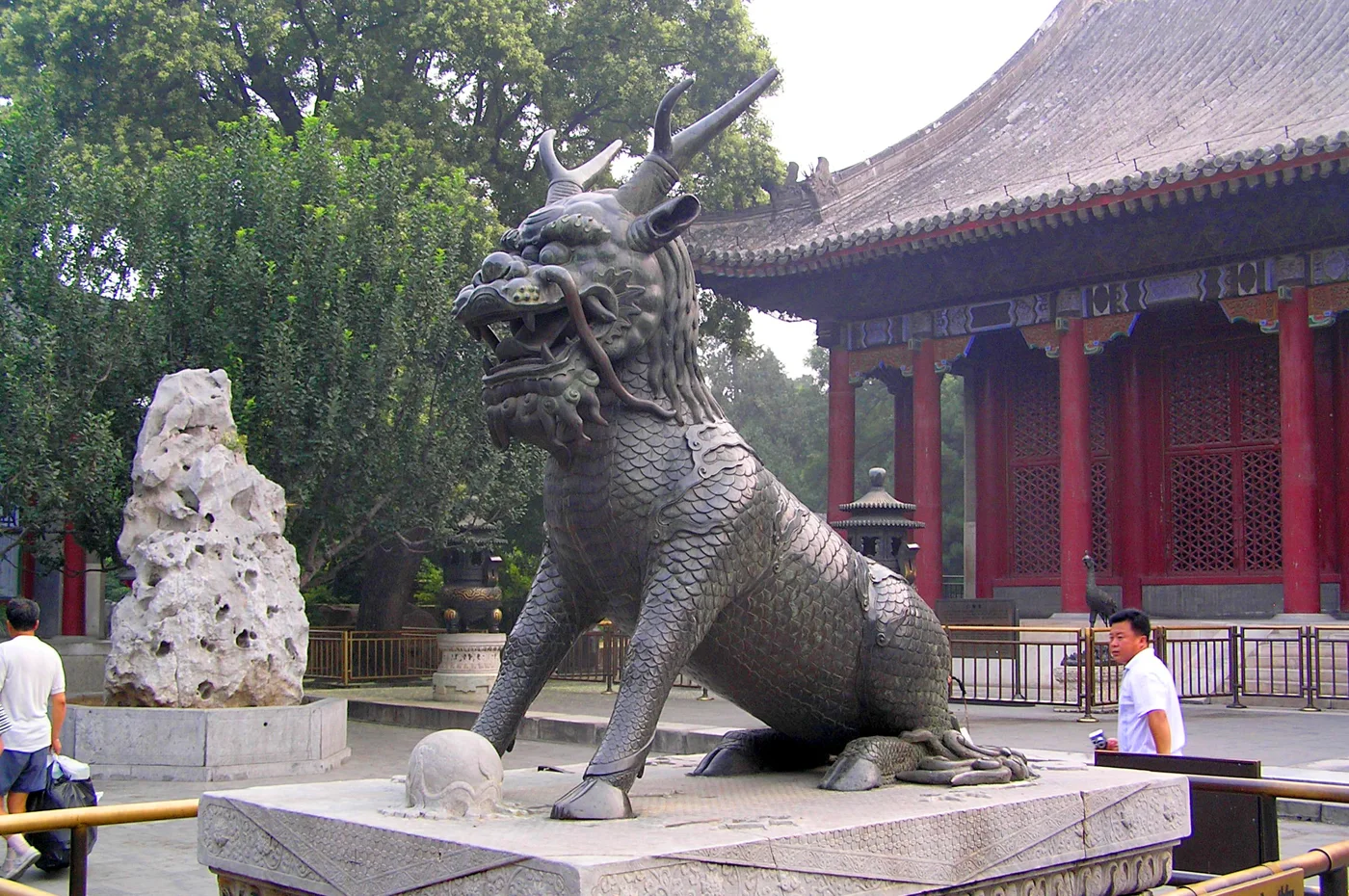
A bronze qilin at the Summer Palace in Beijing. Compare its full silhouette with the separately credited winged-beast photograph below. These are particular photographed sculptures, not a universal identification key. Resized WebP adaptation, CC BY-SA 3.0.
Mr. Tickle (Miguel A. Monjas) / Wikimedia Commons · CC BY-SA 3.0 · Image adapted for display.

Begin with the name on the record.
A qilin and a pixiu can both appear as extraordinary four-legged beasts, combining features that a viewer associates with several animals. That resemblance makes comparison useful, but it also makes a quick identification risky. A horn, a flowing mane or an open mouth is a feature to describe before it becomes an answer. This guide compares documented objects and the language used around them, rather than proposing one timeless body plan for each creature.
Qilin (麒麟), pixiu (貔貅), bixie (辟邪) and tianlu (天祿) are names to preserve in a research note. They should not be silently substituted for one another because an English caption says “mythical beast.” A museum may place several names in one discussion, while the title of its particular object remains more restrained. Keeping both levels visible makes the comparison clearer.
The useful first question is therefore not “How many horns can I count?” but “Who called this object what, and when is the object dated?” A named Qing textile and an early bronze figure can share hybrid features without serving the same purpose. Their material, scale and setting can explain more than the isolated outline.
A textile and a seal carry different evidence.
The Metropolitan Museum of Art titles accession 46.133.2 Rank Badge with Qilin and dates it to the late seventeenth century, within the Qing dynasty. Here qilin is an explicit collection identification. Equally useful is the object category: a rank badge is an image carried on a textile, not a free-standing animal sculpture. Its rectangular field and surrounding decoration belong to the composition one is comparing.
The Cleveland Museum of Art offers a different scale and medium in Seal with Reclining Qilin, accession 1952.494, dated 1736–95 in the Qianlong reign. The museum specifies tianhuang stone. A viewer should not replace that material with “jade” because the object belongs to a familiar Chinese carving tradition. Its title connects the reclining creature with a seal; the stone and the object category are independently recorded facts.
These two qilin-labelled objects already complicate a silhouette test. A compact carved figure must occupy the top of a small object; an animal in a textile composition can extend across a flat field. Posture, viewing angle and the demands of the medium affect what is visible. Neither example is a template with which to certify every modern pendant.
Keep the bronze’s museum name.
A historical comparison is Cleveland accession 1980.184, titled Winged Chimera (Bixie), dated to the 400s CE in the Southern and Northern Dynasties period. The museum gives its overall size as 6.7 by 7 centimetres. This is a small object, even though its museum photograph can make its raised chest and open mouth feel monumental. Read the measurement before imagining an architectural setting.
In the museum photograph linked in the source record, the head turns toward the viewer and the mouth opens above a broad chest. Curled, layered forms appear at the shoulders, and the feet have projecting digits. The mottled green surface is visible; the identification of the medium as bronze comes from the catalogue. Colour alone would not identify an unknown object’s metal, age or surface treatment.
The museum describes bixie as a hybrid creature associated with a belief in warding off evil spirits. That explains an attributed cultural role. It is not evidence that the bronze prevents harm, and it does not establish the original placement of this particular small figure. The public record consulted here does not provide an excavated tomb location. We retain the title Bixie rather than relabel that museum object as a verified pixiu.
Pixiu and bixie meet in attributed accounts.
The National Palace Museum Southern Branch’s selection titled 神獸, or mythical beast, is labelled Han. Its accompanying account describes a horned, lion-like winged bixie and discusses monumental guardians beside tomb paths in the Northern and Southern Dynasties. It then presents the association of bixie and pixiu as another explanation, connecting their similar sounds. This is a museum’s account of a relationship between names, not proof that every use of the two terms is identical.
That account also explains later wealth imagery through a story about retaining what is taken in, and mentions paired displays holding coins. Such a narrative helps a reader understand why a contemporary pixiu ornament may be presented with money imagery. It does not demonstrate financial results. A museum’s discussion of a later association should not be backdated automatically onto every Han object described in the same page.
The National Museum of History in Taiwan supplies another concrete example: Bronze bixie, accession 92-00229, attributed to the Western Han. Its collection description discusses pixiu alongside the names tianlu and bixie, and describes the figure turning its head back. We cite its naming practice without reproducing its photograph here. This example matters because it documents overlap in a particular institution’s account while leaving Cleveland’s different title intact.

Compare features without making a key.
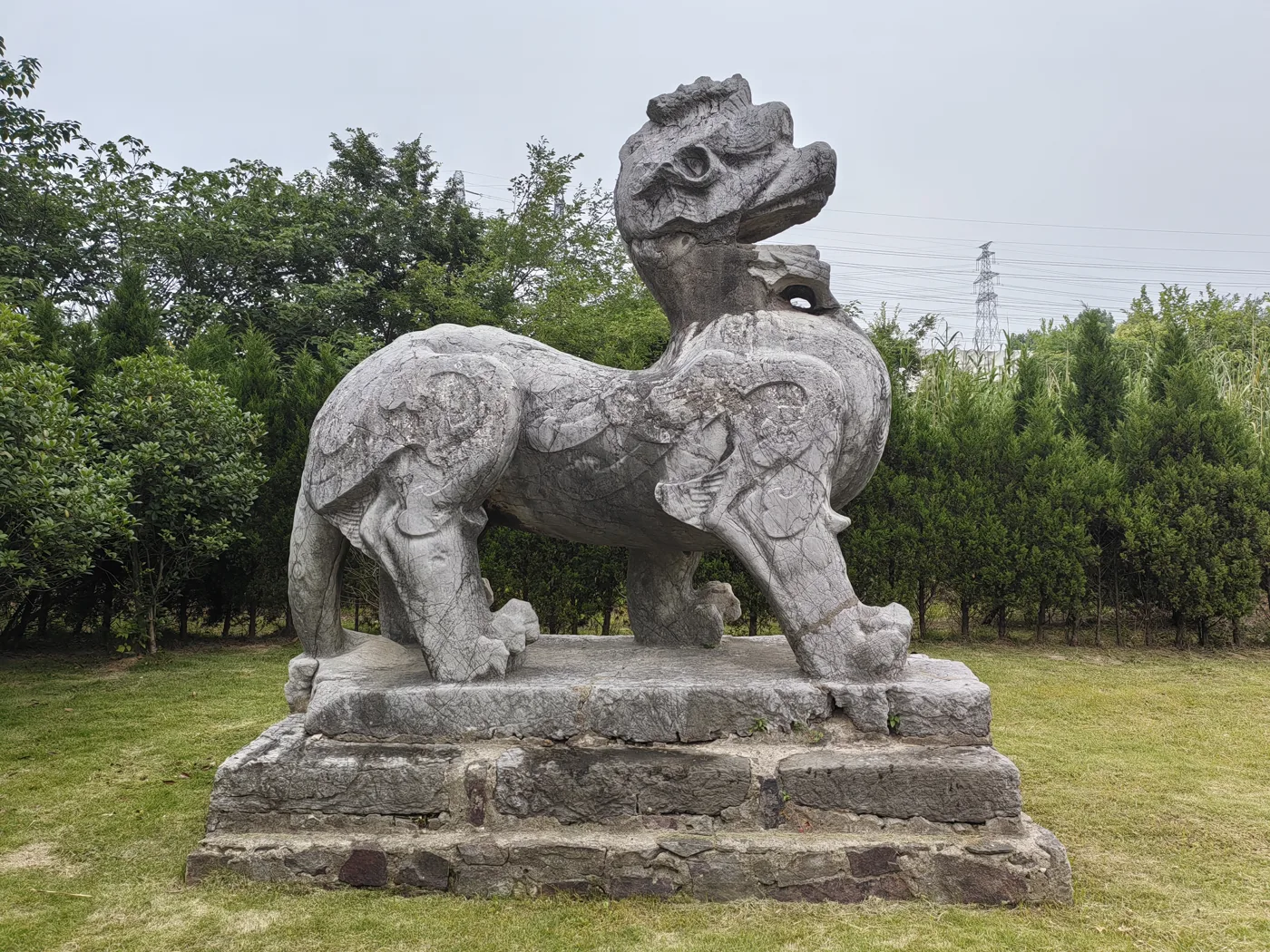
Wings are worth recording: are they clearly modelled projections, incised marks or shapes obscured by the angle? In the Cleveland bronze, shoulder forms are prominent. In a cropped textile image, the same question might be harder to answer. An unseen wing is not necessarily an absent wing, and absence in one object does not define a whole category.
Horns also need a source and a view. The National Museum of History’s description reports a traditional distinction between one-horned tianlu and two-horned bixie. Present that as the distinction in that account. Applying it as a universal rule would disregard differences of period, label, damage and artistic convention, and would still not tell a reader whether an unknown figure is a qilin or a modern pixiu.
Feet, tails and mouths can be described in the same measured way. Note visible digits or a split hoof shape only where the image permits it. Do not infer a hidden underside or anatomy from a story about a creature. A coin-like disk beside an animal may invite a question about wealth imagery; its presence alone cannot prove a date, a traditional name or a claim made by its maker.
Read the objects side by side.
The comparison below separates museum titles, dated material objects and the questions they can answer. It is intentionally a comparison of examples rather than a taxonomy of all Chinese beasts. The earliest item here is not necessarily the origin of a name, and the latest object does not establish that all earlier forms developed toward it.
Try writing a caption in two sentences. First give the institution’s title, accession, date and medium. Then state the feature you can actually see or the interpretation attributed to that institution. If those sentences cannot be kept separate, return to the record: the difficulty often reveals where an assumption has entered the description.
| Object and date | Recorded material and category | What to keep separate |
|---|---|---|
| Met 46.133.2, late 17th century | Rank Badge with Qilin; textile | A named image on a badge, not a universal body plan. |
| Cleveland 1952.494, 1736–95 | Seal with Reclining Qilin; tianhuang stone | Stone, carved posture and seal context; do not substitute jade. |
| Cleveland 1980.184, 400s CE | Winged Chimera (Bixie); bronze | A small hybrid figure; not relabelled as a verified pixiu. |
Use resemblance as a question.
When comparing an unfamiliar ornament, begin with the maker’s supplied name and a neutral visual description. Ask whether a reliable record gives its material, date and intended context. A resemblance to Cleveland’s bronze can support a visual comparison, but cannot transfer the bronze’s catalogue date, ownership history or identity to the new object. An image is also insufficient for assessing a carving’s authenticity.
For a dragon-like head or a lion-like mane, compare the whole composition. A borrowed feature does not require that the entire creature be renamed a dragon or a lion. Likewise, “auspicious beast” can be a useful broad description where a narrower identification is uncertain. Broad wording is most useful when paired with the specific information that is known, rather than offered as an explanation by itself.
For a longer account of the qilin’s changing image, continue to our qilin guide. For contemporary pixiu terminology and the difference between symbolic interpretation and a promised effect, continue to the pixiu guide. The skill to take into either reading is simple: preserve the object’s label, state the date and medium, describe what is visible, and attribute the interpretation to its source.
Qilin: names, images and historical context · Pixiu: symbolism and interpretation · Chinese dragon imagery
Sources and context
Sources consulted on 2026-11-05. Collection titles and dates are retained; historical beliefs are attributed interpretations. Photographs cannot authenticate an unfamiliar object.
- Rank Badge with Qilin — The Metropolitan Museum of Art
46.133.2; late seventeenth-century Chinese textile. Museum title and date; not a universal anatomical definition.
- Winged Chimera (Bixie) — The Cleveland Museum of Art
1980.184; 400s CE; bronze; CC0 photograph. Museum identification retained.
- Seal with Reclining Qilin — The Cleveland Museum of Art
1952.494; 1736–95; tianhuang stone; comparison with a small carved qilin.
- 神獸 (Mythical beast) — National Palace Museum, Southern Branch
Han-labelled selection; museum explanation of the association of bixie and pixiu and later wealth imagery, attributed rather than universal.
- 青銅辟邪 (Bronze bixie) — National Museum of History, Taiwan
92-00229; Western Han attribution; collection account uses pixiu, tianlu and bixie as related names. No image reproduced.
- Summer Palace qilin — photograph — Mr. Tickle / Wikimedia Commons
Photograph identity and CC BY-SA 3.0 licence.
- Tianlu at the Shizichong tomb — photograph — Yumeto / Wikimedia Commons
Photographer-supplied Tianlu name and 2024 photo date; side-view comparison and CC BY-SA 4.0 reuse terms, not confirmation that Tianlu and Pixiu labels are interchangeable.
The Summer Palace qilin photograph is CC BY-SA 3.0, and the side-view Tianlu photograph is CC BY-SA 4.0. Both are resized without cropping or recolouring, with image-specific credits and licences. The Cleveland bronze remains labelled Bixie in the discussion; its photograph is not reproduced here. The National Palace Museum and National Museum of History records supply context for names; their images are not reproduced.