
Images, objects & interpretation
Chinese dragon symbolism, history and appearance
Read a dragon through its object and setting. A jade pendant, a painted handscroll and a modern bracelet do not provide the same evidence.
AI-assisted local candidate · Sources checked 28 October 2026 · Independent cultural-history review pending.
What does a Chinese dragon symbolize?
The Smithsonian’s Eleven Dragons teaching guide associates dragons with water, rain and imperial power in Chinese art. It also says the meaning of the earliest dragon images remains uncertain. These are historical interpretations, not evidence that wearing a dragon produces power, protection or good fortune.
Start by asking who made the object, when, and for which setting. For a paired motif, use the separate dragon and phoenix guide; for the directional Azure Dragon, use the Four Symbols.
Two dated records, not a single origin story
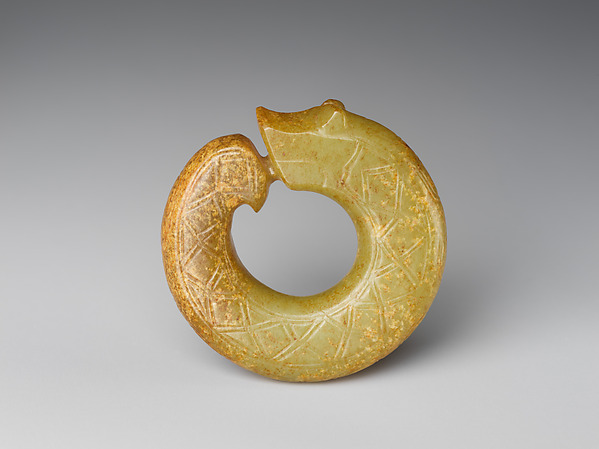
A coiling dragon in nephrite
The Met dates pendant 2019.193.1 to the 13th–12th century BCE and catalogues its material as jade (nephrite). Its Chinese title includes 玉蟠龙佩. This is one dated museum record, not a claim to the first dragon image.
For what that material name establishes, read nephrite versus jadeite and jade in Chinese cultural contexts.
A Ming handscroll with a changing attribution
The Smithsonian teaching record dates Eleven Dragons, F1919.173, to about 1400–1500. It records a former attribution to Chen Rong while describing the work as by an anonymous Ming artist. The older artist attribution should not be used as the painting’s confirmed date or authorship.
What do Chinese dragons look like?
In that handscroll, the museum describes long, serpent-like bodies with horns, scales and claws, moving through clouds and water. These are features of the painting discussed in the guide, not a fixed anatomical checklist for all periods or media.
When studying a Chinese dragon drawing, follow the museum’s full scroll and looking questions. Compare the outline, pose and setting against the identified work. This page offers object-based visual reading, not a step-by-step drawing tutorial or downloadable tracing pattern.
Do Chinese dragons have wings?
The answer cannot safely be reduced to one rule. Our dragon and phoenix page links a British Museum winged fish-dragon record and explains its access limitations. A named example does not establish the appearance of every Chinese dragon.
Mythology, nine sons and spiritual claims
A museum interpretation of imagery is different from a complete account of Chinese dragon mythology. If a claim names a deity, a particular dragon or an early text, ask for that specific record. A modern list does not supply the missing historical evidence.
Read one sourced account of the nine dragon sons separately. It explains why the sons are not a universal classification of dragon species. Neither guide assigns a guaranteed spiritual effect to jewelry or tattoos.
Sources, image rights and next steps
- The Met: Pendant in the shape of a coiling dragon — material, date, Chinese title, accession and public-domain image label.
- Smithsonian National Museum of Asian Art: Eleven Dragons — teaching record for F1919.173, interpretation and former attribution. It is an archived museum page; the current collection endpoint was unavailable during this check.
The existing Met Open Access photograph is reused with its record and credit. Smithsonian text is summarized and linked; its scroll image is not reproduced here. Further specialist review should compare early texts, changing catalogue attributions and the scope of interpretations before publication.
Next: compare the nine sons account, or return to the source-linked reference library.