
Nephrite vs Jadeite
软玉 / 翡翠 ruǎnyù / fěicuì
Two materials commonly called jade: compare names, structure and hardness without treating appearance as authentication.
Sources checked 28 October 2026 · Specialist review of the original four guides reported by the site owner; newer notes are identified below
Compare the materials
| Question | Nephrite | Jadeite jade |
|---|---|---|
| Mineral family | Amphibole | Pyroxene |
| Mohs hardness | 6–6.5 | 6.5–7 |
| Toughness | Exceptional | Exceptional |
| Identity from a photograph? | Not established | Not established |
GIA jade care and cleaning guide ↗ · GIA jade description ↗
New comparison notes: source-checked; independent specialist review pending.
Scientific fact
Two different material groups
Nephrite and jadeite jade are distinct materials commonly grouped under the word jade. GIA describes both as rocks made of fine, interlocking mineral crystals; it also includes some green omphacite under certain conditions.
Scientific fact
Hardness is not toughness
GIA gives jadeite a Mohs hardness of 6.5–7 and nephrite 6–6.5. Hardness describes resistance to scratching; toughness concerns resistance to breaking. Both are exceptionally tough, but neither is indestructible.
Modern commercial terminology
Names do not certify an object
Fei cui is a traditional Chinese term associated with jadeite, but GIA notes that the trade term can cover other materials. A label, colour or photograph alone does not establish an object’s identity or treatment.
Historical evidence
Look at an object, not a category alone
The Met identifies its coiling dragon pendant as nephrite and dates it to the 13th–12th century BCE. That is evidence about this object, not proof of the origin or meaning of all jade pendants.
Source: The Metropolitan Museum of Art ↗
What this reference cannot tell you
Trade and laboratory terminology varies; individual stones, treatments and origin require appropriate examination.
Common questions
New comparison notes: source-checked; independent specialist review pending.
Is nephrite or jadeite better?
There is no single best choice for every piece. GIA describes both as exceptionally tough; its hardness ranges overlap. Consider the actual object, its condition and treatment, the workmanship, your preferences and the evidence for the material claim rather than treating a name or color as proof of quality.
Source: Gemological Institute of America ↗ · Gemological Institute of America ↗
Is Burmese jade the same as Hetian jade?
Myanmar (Burma) and Hetian are geographic or trade references, while jadeite and nephrite name different materials. A geographic or market name does not itself identify an individual piece or establish where it was mined. Ask separately for material identification and evidence for a specific origin claim.
Source: Gemological Institute of America ↗ · Gemological Institute of America ↗
How are nephrite and jadeite different?
Nephrite is a rock dominated by amphibole minerals, while jadeite jade is dominated by the pyroxene mineral jadeite. Both are sold as jade, and each can contain other minerals. A color or photograph alone cannot establish identity.
Is Hetian jade the same as jadeite?
Hetian and Hotan refer to a place associated with nephrite, and Hetian is also used as a trade name. Nephrite and jadeite are distinct materials. Ask separately about mineral identification and the evidence for any origin claim.
Source: Gemological Institute of America ↗ · Gemological Institute of America ↗
Objects in context
Use the collection records to inspect dates, material and the limits of each attribution.
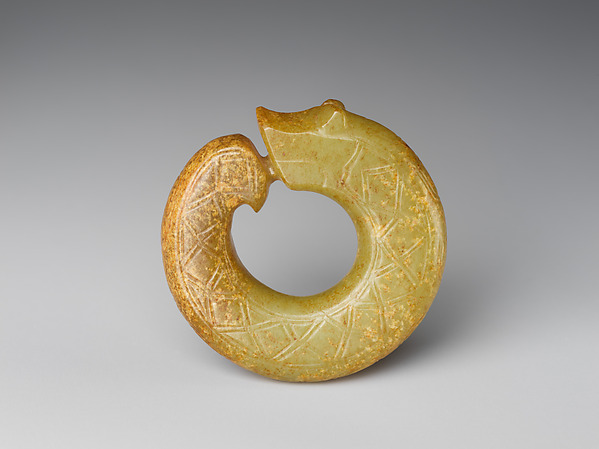
玉 yù
Pendant in the shape of a coiling dragon
A small coiling dragon carved in nephrite, catalogued by The Met.
- Date
- 13th–12th century BCE
- Material
- Jade (nephrite)
- Collection
- The Metropolitan Museum of Art · 2019.193.1
- Place
- China
The attribution describes this object; it does not identify another object or establish a single meaning for all dragon pendants.
View the museum record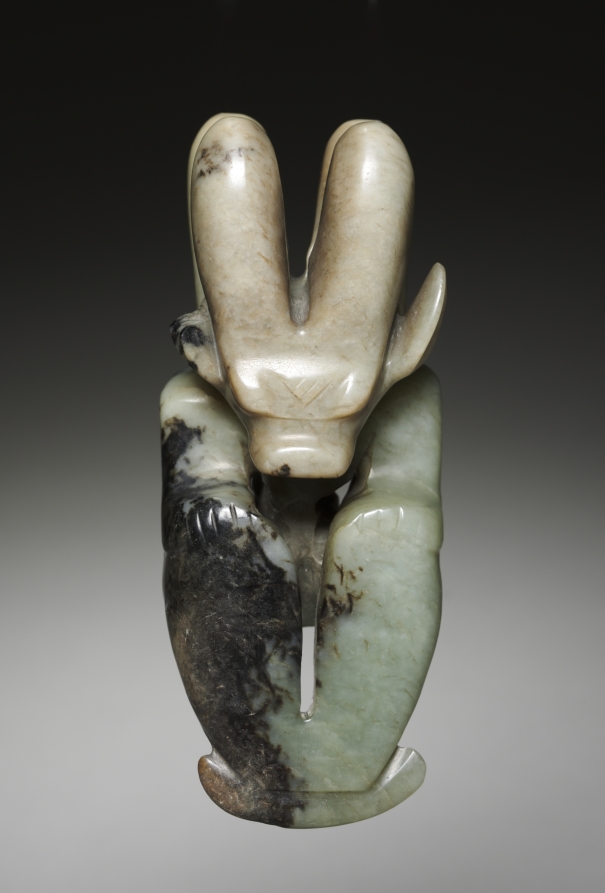
牛首玉人 niú shǒu yù rén
Amulet in the Form of a Seated Figure with Bovine Head
A nephrite figure tentatively associated with Hongshan culture.
- Date
- c. 4700–2920 BCE
- Material
- Jade (nephrite)
- Collection
- The Cleveland Museum of Art · 1953.628
- Place
- Northeast China; probably Hongshan culture
The museum describes the cultural attribution as probable; the original meaning is not established by shape alone.
View the museum recordSources & further reading
- Jade description — Gemological Institute of America
- Jade care and cleaning guide — Gemological Institute of America
- Pendant in the shape of a coiling dragon, 2019.193.1 — The Metropolitan Museum of Art
- The Nephrite Jade Road — Gemological Institute of America
Manage the same analytics choice used across OrientLore.