
Qilin: changing images and attributed meanings
Read qilin imagery through dated museum objects, translation boundaries and courtly narratives, without reducing it to a Western unicorn.
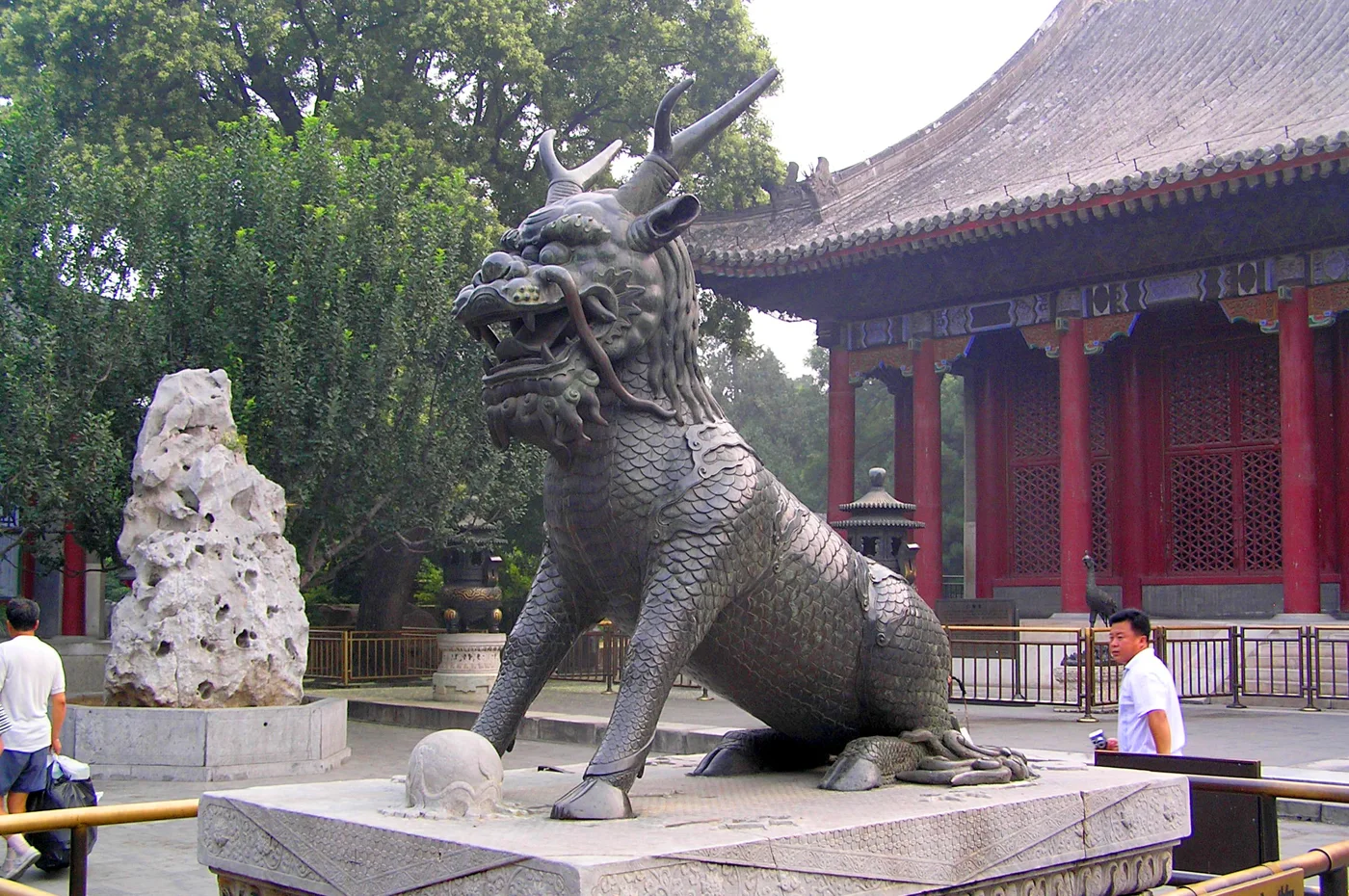
Bronze qilin photographed at the Summer Palace in Beijing. The raised horns, open mouth, scaled body and legs are visible together. This photograph illustrates one particular sculpture, not a universal identification rule. Resized to WebP without cropping or recolouring; adaptation distributed under CC BY-SA 3.0.
Mr. Tickle (Miguel A. Monjas) / Wikimedia Commons · CC BY-SA 3.0 · Image adapted for display.

Qilin is a name, not a unicorn diagram.
Qilin, written 麒麟 and romanized qílín, names a creature in Chinese cultural imagery. English labels sometimes call it a “Chinese unicorn.” That comparison can help a reader find a catalogue entry, but it can also suggest an ordinary horse with one straight horn. The objects in this guide show why the Chinese name is more useful than that mental picture.
Begin with the named object rather than an ideal animal assembled from several descriptions. A museum may identify a reclining stone creature as a qilin, while another record gives that name to an animal in a carved procession. Those labels belong to particular works. They do not promise that every artist followed an identical outline or that a modern ornament with similar features has the same identity.
Keep a translated label beside the original name when taking notes: “qilin, described here as a mythical creature.” This leaves room for differences of medium, period and interpretation. It also avoids importing a European unicorn story into a Chinese object without evidence. Translation can open a comparison; it should not silently replace the cultural subject being compared.
An early image sits among other animals.
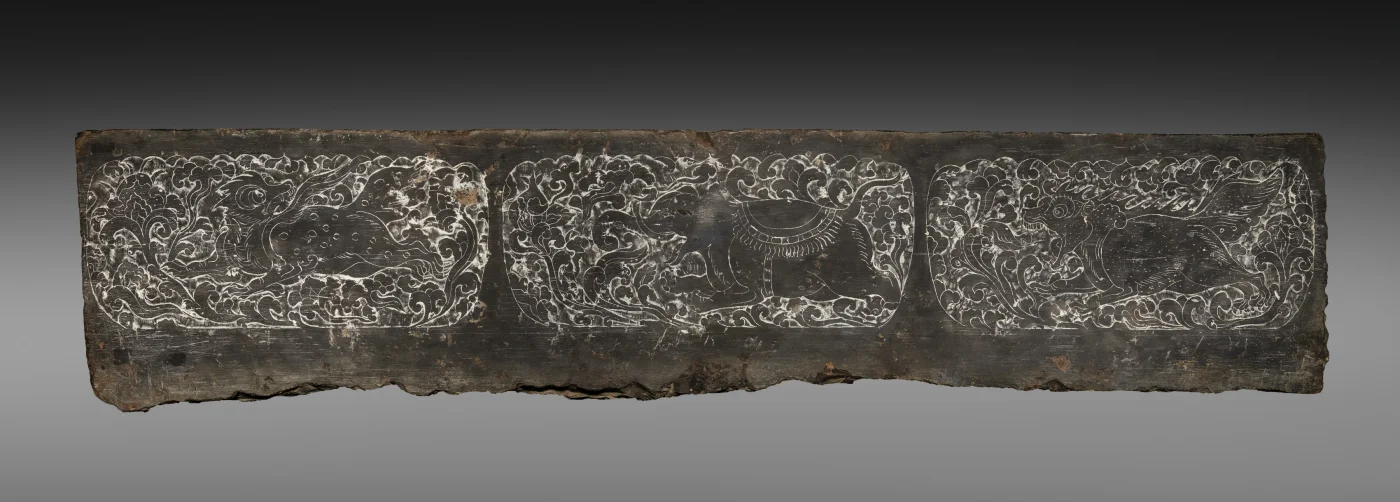
Cleveland’s Section of a Sarcophagus Foundation or Epitaph Stone, accession 1959.184, is dated to the late 600s–early 700s, within the Tang dynasty. The museum identifies a qilin, an elephant and a chimera in its carved decoration. It proposes two possible original settings: a coffin foundation or an epitaph stone. That uncertainty should remain visible when describing the fragment.
Look across the surviving panels before isolating the left-hand animal. The creatures share a field of curling vegetation; the image is an arrangement with neighbours and repeated borders. A cropped picture of one head would remove much of that information. Keeping the entire fragment in view helps explain that a mythical animal could participate in a larger decorative programme.
The museum connects the mixture of real and imaginary animals with Tang funerary art. This is an interpretation of an archaeological and artistic context, not evidence that the carved creature performed a physical protective action. Nor does the date of this surviving object establish when qilin imagery was invented. An early example in a small selection is not necessarily the earliest example anywhere.
A later carving changes the encounter.
Another documented example is Cleveland’s Seal with Reclining Qilin, accession 1952.494, dated 1736–95, the Qianlong reign of the Qing dynasty. Its material is tianhuang stone. The museum gives an overall height of 6.4 centimetres. The animal is part of a small seal object, a very different format from the Tang architectural or funerary fragment.
In the photograph, the creature folds into a compact mass above the upright base. Its head turns back, and incised strands mark the mane and body. The museum’s image description calls attention to a single curved horn. These are useful observations about this carving; they should not become compulsory criteria for every qilin in another collection.
Scale changes how a viewer encounters the image. A small carving can reward close attention to the turn of the head and the separation of limbs from the base. A photograph enlarged on a screen can make it seem monumental. Retaining the catalogue dimensions prevents that visual impression from becoming a mistaken statement about the object.
The date is a reign-period attribution supplied by the museum, not an exact day of manufacture. The photographed side also does not reveal everything about the seal’s working surface. We can discuss the labelled animal without inventing an owner, a document it authenticated or a specific occasion on which it was used.
A giraffe could enter a qilin narrative.
The Met’s eighteenth-century Scroll Cover with Mythical Creature, accession 41.123.3, is silk embroidery on gauze. Its account discusses a qilin representation and compares its patterned coat with an earlier badge associated with Duke Xu Fu, who died in 1517. A comparison with another work is part of the interpretation; the eighteenth-century textile itself should not be redated to that earlier moment.
The same curatorial account places the animal in a courtly story of auspicious rulership. It recounts a giraffe presented to the Yongle emperor in 1414 and officials’ identification of the animal with a qilin. In that setting, naming could support flattering claims about the ruler’s legitimacy. The historical interest lies in the language and political setting of the claim, rather than in proving a supernatural sign.
A giraffe and a mythical creature are not interchangeable categories in a modern zoological description. Yet the courtly identification helps explain why an image associated with qilin might look unexpected to someone who knows only a horned, lion-like sculpture. Read the museum’s argument as an account of interpretation in a particular setting, not as a rule for identifying every long-necked animal in Chinese art.
The Met also connects qilin badges with Ming nobles. That does not establish that every textile carrying a qilin was worn by a noble, or that its present title describes its entire earlier history. When a catalogue discusses a garment association and an object now catalogued as a scroll cover, retain both pieces of information instead of smoothing them into an invented biography.
Different objects do not make a simple evolution chart.
Place the Tang fragment, the Qing seal and the embroidered textile next to one another in your notes. Their dates establish a sequence of particular objects. Their materials and formats establish different artistic tasks: carving shallow lines in stone, shaping a compact three-dimensional animal, and building a coloured surface with thread. A difference in appearance need not be explained by chronology alone.
This selection demonstrates variation; it does not demonstrate that one type replaced another across China. To argue for a broad historical transition would require many more dated objects, information about workshops and regional practices, and attention to which works survived. Three catalogue records cannot stand in for an uninterrupted history of an entire visual tradition.
For the same reason, resist a checklist that awards identity according to horn count, scales, hooves or a curling mane. Features can help describe what is visible, but a label, provenance and context can change the interpretation. A cropped photograph may conceal precisely the feature someone proposes as decisive. Record what can be seen and what cannot before choosing a name.
Attribute the story before explaining its meaning.
“Auspicious” describes a favourable association in the Met’s account. It is not a measurable property of the embroidered silk or carved stone. A useful sentence names the interpreter and the setting: “The Met relates this qilin imagery to ideas of virtuous rulership.” A less useful sentence turns that account into a promise that a qilin object will produce good government or personal success.
Stories, objects and later explanations also answer different questions. An object can show that an image was made in a particular material and period. A narrative may explain why that image mattered to a speaker or audience. A modern caption can connect the two, but the connection needs to be stated and sourced; it cannot be assumed merely because both use the word qilin.
This guide follows the courtly narrative documented in the linked museum account rather than supplying a universal origin tale. Readers encountering a family, temple or festival story elsewhere should preserve its named source and setting. Ask who tells it, which object or occasion it addresses, and whether the explanation belongs to the historical record or to a later interpretation.
Build a caption that another reader can check.
For the seal, a practical caption might read: “Reclining creature identified as a qilin by the Cleveland Museum of Art; tianhuang stone; Qianlong reign, 1736–95; accession 1952.494.” This supplies identity, authority, material, date range and a stable reference. The visible turned head can be added as observation without pretending that it establishes the name independently.
For the Tang fragment, retain the alternative functions in the title. Write “possibly from a coffin foundation or an epitaph stone,” following the museum, rather than assigning it confidently to a tomb doorway. The distinction matters because a proposed original setting and a documented findspot are different kinds of evidence.
For an unlabelled modern carving, start with the information actually available: the seller’s name for it, the visible animal form, dimensions if supplied and any documented material. Keep a contemporary product description separate from a museum attribution. A resemblance to a historic example does not establish age, workshop, stone type or authenticity.
Continue with our qilin-and-pixiu comparison for the harder problem of neighbouring beast labels. It compares documented examples while keeping uncertain identifications open. The dragon guide offers another route into composite imagery; neither a shared horn nor a dramatic pose should erase the different names and contexts supplied by the records.
Compare qilin, pixiu and similar beasts · Read Chinese dragon imagery
Questions about qilin
- Is a qilin the same as a Western unicorn?
- “Chinese unicorn” is a translation encountered in English, but the dated objects here do not share a single horse-and-horn outline. Keep the name qilin and read each object’s context.
- Can one horn identify a qilin?
- One visible feature cannot securely identify an unfamiliar object. Compare the catalogue label, date, material and setting instead of treating horn count as a universal rule.
- Does auspicious imagery promise an actual result?
- No. Auspicious associations describe attributed cultural meanings; these sources do not establish that an ornament changes luck, health or political outcomes.
Sources and context
Museum object records consulted on 2026-11-05. Dates and identifications follow the named collections; interpretations are attributed in the article.
- Seal with Reclining Qilin, 1952.494 — Cleveland Museum of Art
Qianlong reign, 1736–95; tianhuang stone; dimensions and CC0 image.
- Section of a Sarcophagus Foundation or Epitaph Stone, 1959.184 — Cleveland Museum of Art
Tang limestone fragment, late 600s–early 700s; labelled animals and alternative proposed original settings; CC0 image.
- Scroll Cover with Mythical Creature, 41.123.3 — The Metropolitan Museum of Art
Eighteenth-century embroidery; museum interpretation of courtly qilin imagery, Ming badges and the 1414 giraffe presentation.
- Qilin Statue at the Summer Palace in Beijing — photograph — Mr. Tickle / Wikimedia Commons
Photograph identity and CC BY-SA 3.0 reuse terms; not independent confirmation of the sculpture’s date or provenance.
The Cleveland stone-fragment photograph is supplied under CC0. The Summer Palace cover photograph by Mr. Tickle (Miguel A. Monjas) is supplied under CC BY-SA 3.0; its resized WebP adaptation uses the same licence. Neither image was cropped or recoloured. Object photographs document particular works, rather than a universal anatomy for mythical creatures.