
Gourds: plants, vessels and images in Chinese culture
Distinguish the bottle-gourd plant, worked shells and gourd-shaped objects through documented examples, with clear limits on function and symbolic interpretation.
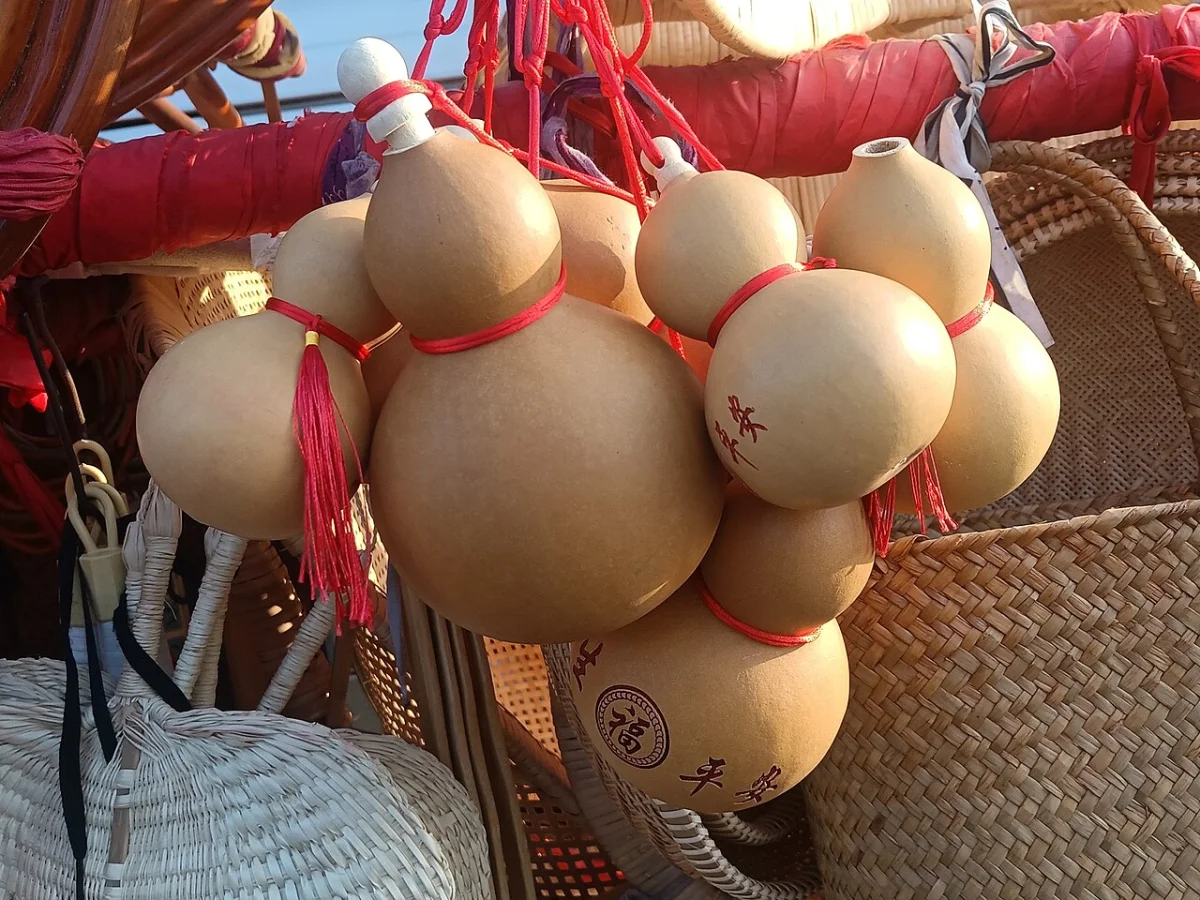
Yellow bottle gourds with visible narrow waists, rounded lobes and red cord attachments. This contemporary photograph illustrates their recognizable form and display; it does not establish their contents, intended use or symbolic effects.
Fumikas Sagisavas / Wikimedia Commons · CC0 · Image adapted for display.

One outline, different things.
An object called a gourd may be a fruit, a dried plant shell, or a vessel made in the fruit’s shape. In Chinese, 葫蘆 or 葫芦 (húlu) is a useful starting word, but it does not settle which of these things a caption describes. Begin with material and construction before looking for an interpretation.
The bottle-gourd plant is identified as Lagenaria siceraria by Singapore’s National Parks Board. Its page distinguishes the growing fruit from mature hard shells that can be processed into containers or instruments. That distinction gives us a practical reading framework: growth, working a plant material, and representing a form are separate questions.
A narrow waist and two rounded lobes can be observed in an image without identifying its substance. A carved stone bottle may imitate plant growth while having no dried shell in its construction. A glaze can create a surface colour that says little about what is underneath. Keep the object record beside the photograph.
A plant is not a finished vessel.
The NParks plant page, linked in the sources, identifies the bottle gourd as Lagenaria siceraria and illustrates its growing form. A botanical example is not documentation of a Chinese ceremony. Its identification should remain separate from claims about the use of a manufactured object.
When viewing a growing fruit, look for its connection to the stalk and its outer surface. A growing fruit has not become a container merely because its outline resembles a bottle. The NParks description explains that mature fruit can develop a hard exterior and be processed for other uses; a single image does not show that transformation.
Do not assume all bottle gourds have the exact proportions of a familiar double-gourd ornament. A cultivar, growth stage and camera angle can affect what you see. This guide does not identify an unfamiliar garden plant from a silhouette, give food-preparation advice or assess whether something is suitable to eat.
A shell needs its own evidence.
When a record says the medium is gourd, it is identifying a material rather than merely an outline. Working a shell into an object can involve an opening, an added rim or attachments, but their presence and purpose must be documented for the particular item. A round body does not prove that it held water.
For a Chinese example, the Met catalogues Gourd, accession 42.90.18, to the Qing Daoguang period, 1821–50, and lists its medium as gourd. Its short public record does not establish a specific function. It also supplies no image. We therefore link to the object rather than substitute a lookalike photograph or call it a drinking vessel.
This is a useful unresolved case. The plant-material identification is supported; an asserted use as a container, ornament or insect holder is not supplied by that record. General knowledge that shells can be used as containers cannot fill that evidential gap. Keep “material known, function unresolved” in your notes.
For an unknown shell object, a documented opening, interior and closure would help investigate a container hypothesis. Ask for the catalogue description or a conservator’s account instead of handling, opening or filling a collection item to test the idea. An earlier use does not establish present-day suitability for liquids.
A vessel can borrow a plant’s shape.
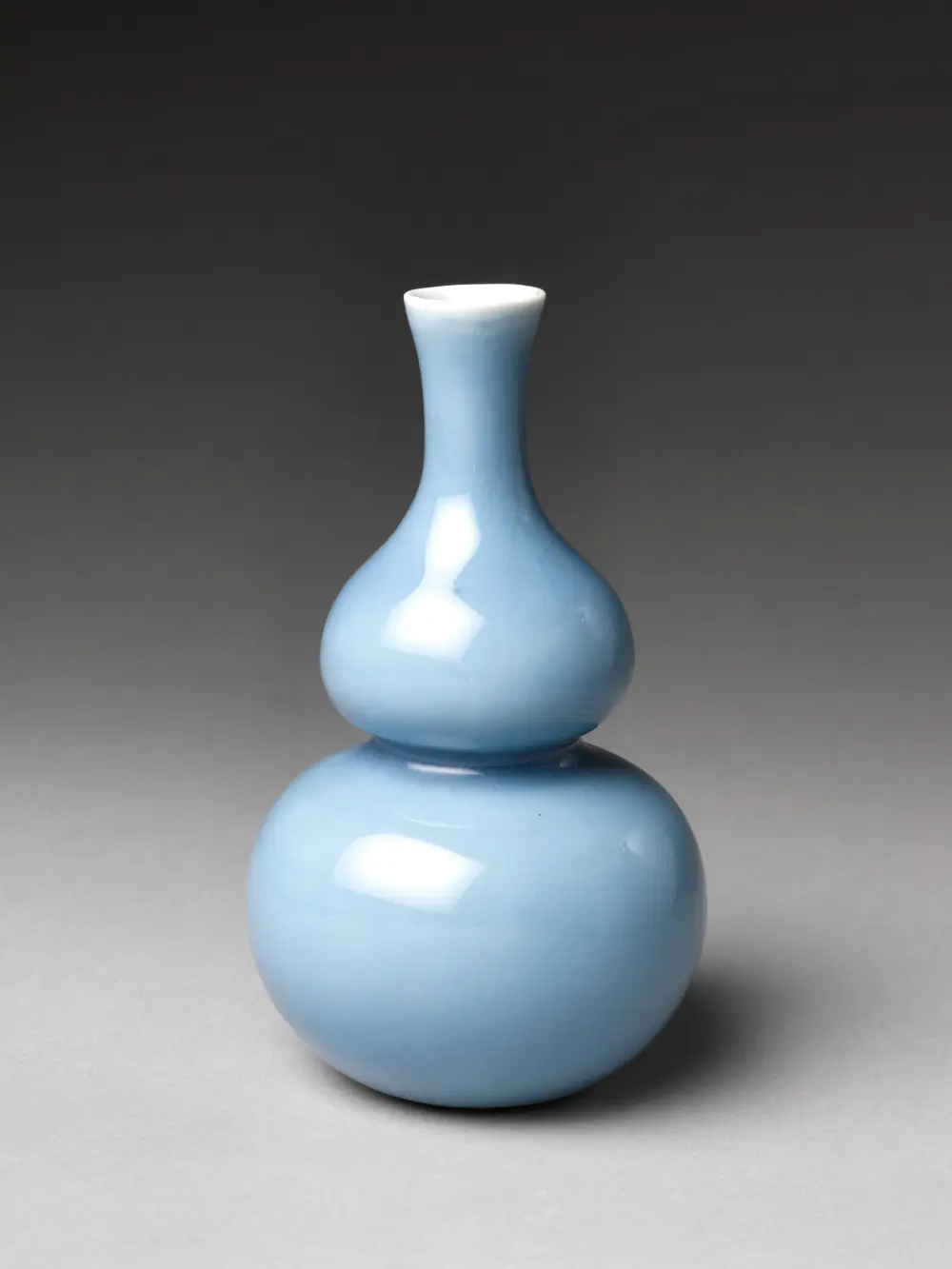
The Met’s Gourd-Shaped Bottle, accession 14.40.27, is an early eighteenth-century Chinese porcelain object with blue glaze, identified as Jingdezhen ware. Here the title points to form while the medium states ceramic. Calling it a bottle gourd without that material distinction would collapse the imitation and its model.
The museum connects the shape to a Daoist story-world in which immortals carry a gourd containing a special drink. That is the curatorial interpretation attached to this object and its form. It does not establish that a historical drink produced immortality or that a modern bottle has a similar effect.
Compare that porcelain example with the carnelian bottle in the linked museum record. Both records describe vessels shaped like gourds, but their materials, dates and surface treatments differ. A shared outline is a starting point for comparison, not evidence that their makers followed one construction process.
The word bottle identifies an object category in the museum record; it does not reveal what was actually put inside. Unless a record supplies residue analysis, a documented inventory or another explicit basis, contents remain a separate question. A title is not a food-contact or materials-safety certificate.
Read the small gourds as imagery.
The Met also records a nineteenth-century Chinese carnelian bottle, accession 65.86.64a–c. Its curatorial account interprets the small gourds on a vine as an allusion to descendants and continuation of a family. That specific interpretation belongs with the object, its visible decoration and the museum’s explanation.
This is different from saying that every gourd has one fixed meaning. The larger bottle form and the smaller vine imagery can support different parts of a reading. First describe the motifs, then attribute the interpretation. Do not treat a wish for family continuity as evidence that an object changes reproductive outcomes.
The same museum account places gourds in narratives about immortals and extraordinary medicines. We describe that as a traditional narrative context, not as medical information or advice to consume a substance. A container represented in a story need not be a record of ordinary household practice.
Material, title and motif can work together without becoming interchangeable. The carnelian is not the living fruit; the vine decoration is not evidence that the bottle grew in that form; and its historical interpretation does not authenticate a modern ornament that resembles it.
Compare three kinds of evidence.
For the growing plant illustrated by NParks, write: “Bottle-gourd fruit on a vine; no worked opening demonstrated.” The visible growing form supports a plant comparison. Its location or cultural use should not be invented from the fact that it accompanies a Chinese-culture article.
For the shell record, write: “Met 42.90.18; gourd material; Daoguang-period attribution; function unresolved in the public record.” The absence of an image is itself a limit. The record is useful without being an illustration of every possible shell-container use.
For the shaped and decorated vessel, write: “Met 65.86.64a–c; carnelian; nineteenth century; gourd form with additional vine imagery.” Read its attributed interpretation alongside the different blue-glazed porcelain record. This produces a comparison of material, manufacture and image rather than a list of supposed powers.
If a modern ornament has no reliable label, start with an equally restrained description: shape, visible surface, attachments and the information supplied by its maker. Leave substance, date and intended use open where the evidence does not answer them. Colour and a familiar silhouette cannot do all that work.
Ask the next useful question.
Before sharing a caption, separate four notes: what the thing is called, what it is made from, what use is documented and who gives the interpretation. A blank field is acceptable. A confident sentence that silently moves a claim from one object to another is much harder for the next reader to correct.
When an image is cropped, check the original record for its base, mouth and attachments. Those features may help describe construction, but they do not automatically establish function. A stopper shown beside an object and a stopper proven to belong to it are different claims.
For further reading, compare how our Chinese-knots guide separates cord material from pattern and occasion. The cultural-context guide develops the same habit for broader claims. Neither provides an authentication service; the useful skill is learning which question each piece of evidence can answer.
The conclusion is deliberately specific: a gourd can be a plant, a worked shell, a borrowed vessel shape or an image within decoration. Understanding those distinctions makes the cultural reading richer without turning a documented association into a prediction, treatment or instruction for symbolic intervention.
Chinese knots: material and structure · Read cultural claims in context
Sources and context
Sources consulted on 2026-11-04. The Met record with no image is used only for its stated material and attribution, with function unresolved.
- Bottle Gourd — National Parks Board, Singapore
Plant name and mature hard shells processed as containers; not certification of an unknown object.
- Bottle in the shape of a double gourd — The Metropolitan Museum of Art
65.86.64a–c, nineteenth-century Chinese carnelian; attributed imagery of legendary medicines and family continuity.
- Gourd-Shaped Bottle — The Metropolitan Museum of Art
14.40.27, early eighteenth-century Chinese blue-glazed porcelain; Daoist narrative in the curatorial account.
- Gourd — The Metropolitan Museum of Art
42.90.18, gourd material, Daoguang period; no image available and no specific function established by this record.
- Yellow bottle gourds.jpg — Fumikas Sagisavas / Wikimedia Commons
Contemporary yellow double-gourd photograph; CC0. Visible shape and attachments only; contents and use not established.
The public-domain museum image and the contemporary CC0 gourd photograph have separate rights records. Captions name the actual objects; no modern item was physically examined. No preparation, ingestion, cure or symbolic-effect instructions are supplied.