
Chinese knots: craft, forms and everyday use
Explore Chinese knotting through cord, structure and context, with licensed Pan Chang and button-knot images and clear limits on visual identification.
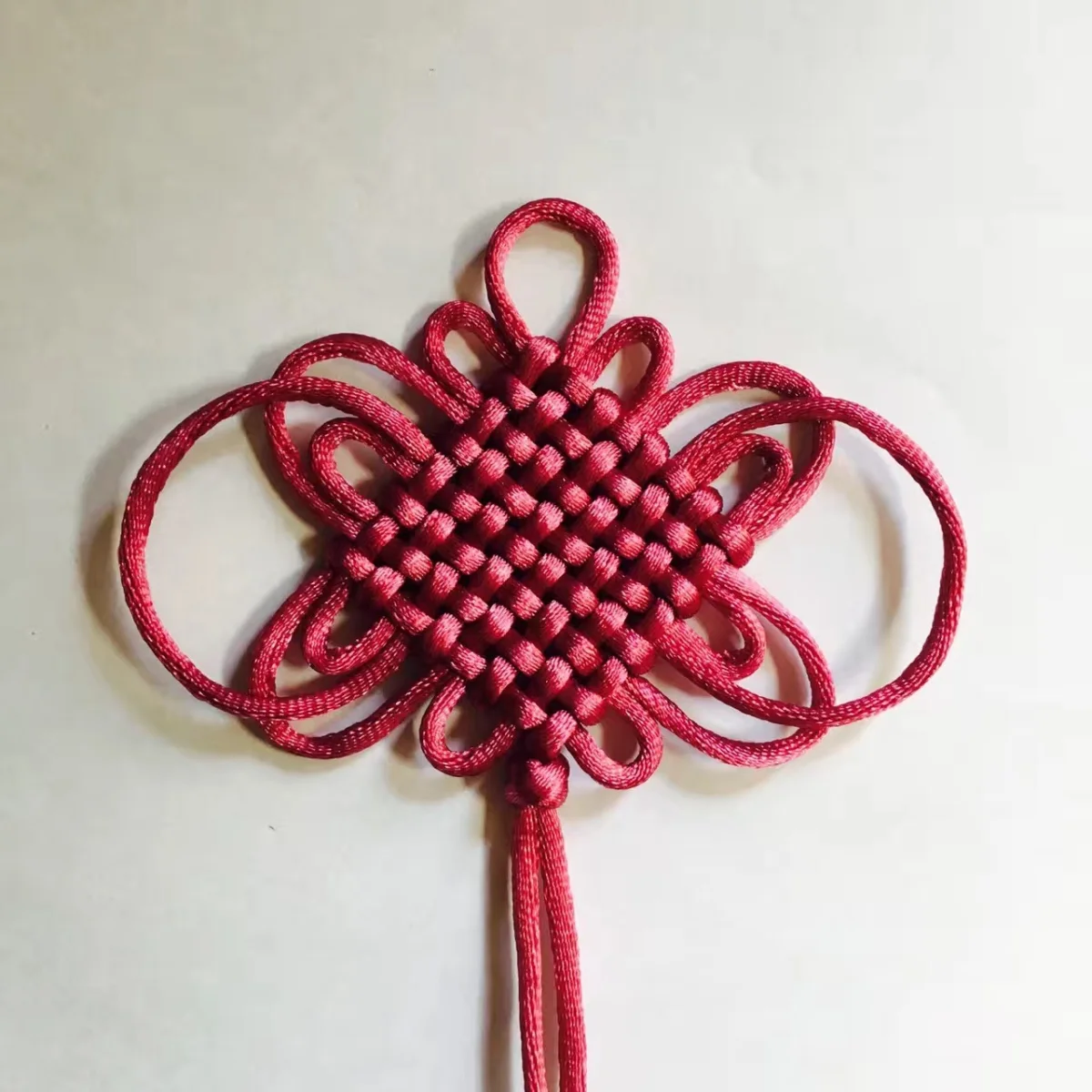
YWang9174 describes this example as an eight-row Pan Chang knot with overlapping ears. Observe the central crossings and outer loops; one front view does not establish the fibre, reverse or every hidden connection. Resized WebP adaptation, CC BY-SA 4.0.
YWang9174 / Wikimedia Commons · CC BY-SA 4.0 · Image adapted for display.

Begin with cord, not a colour.
Chinese knotting, often called 中國結 or 中国结 (Zhōngguó jié), brings flexible cord into deliberately arranged forms. A finished ornament may combine a central knot, outer loops, a hanging loop, beads and a tassel. Those parts do different jobs. The decorative assembly is not necessarily the same thing as the knot structure at its centre.
A material description should say what the record actually identifies. “Red cord” describes an appearance; it does not establish silk, cotton or a synthetic fibre. A glossy surface is not a fibre test, and a photograph cannot show how a cord feels or behaves when tightened. Keep material, colour, structure and use as separate notes.
The HKU-hosted student craft project describes knotting from a length of cord and gives decoration, gifts and clothing as contemporary examples. We use that as a situated introduction, not as proof that every ornament uses a single uncut cord. A complex assembly can contain separate components; hidden joins cannot be ruled out from a frontal photograph.
Making changes the structure.
For a beginner observing a demonstration, it helps to separate laying out the cord, making crossings, adjusting loops and dressing the finished knot. These are observation stages, not a complete tying recipe. An apparent tangle on a work surface may be a deliberate loose stage that looks very different after the maker tightens it.
Watch where the cord passes above or below another segment. Then watch how the maker distributes slack rather than pulling one end indiscriminately. An outer loop can change size without changing the intended crossing sequence. Conversely, one altered crossing may change the structure even if the silhouette still looks familiar.
Ask the teacher which pattern they are demonstrating, which face is shown and what stage is complete. Keep their terminology with the demonstration instead of converting a translated name into a universal rule. This article does not supply a verified step-by-step pattern; use a complete maker-led lesson if your goal is to reproduce a particular knot.
For a small decorative practice piece, compare the starting layout with the finished example before attempting embellishments. Document what you changed. Do not extrapolate an ornament tutorial into a load-bearing fastening, climbing knot or safety attachment. The evidence and requirements for those uses are different.
Two images, two kinds of evidence.
The cover photograph is attributed to YWang9174, whose file description calls it an eight-row Pan Chang knot with overlapping ears. That is the documented name of this example. Look at the repeated central crossings and the loops around the outside. A count taken from this specimen is not a rule that every Pan Chang variation must look identical.
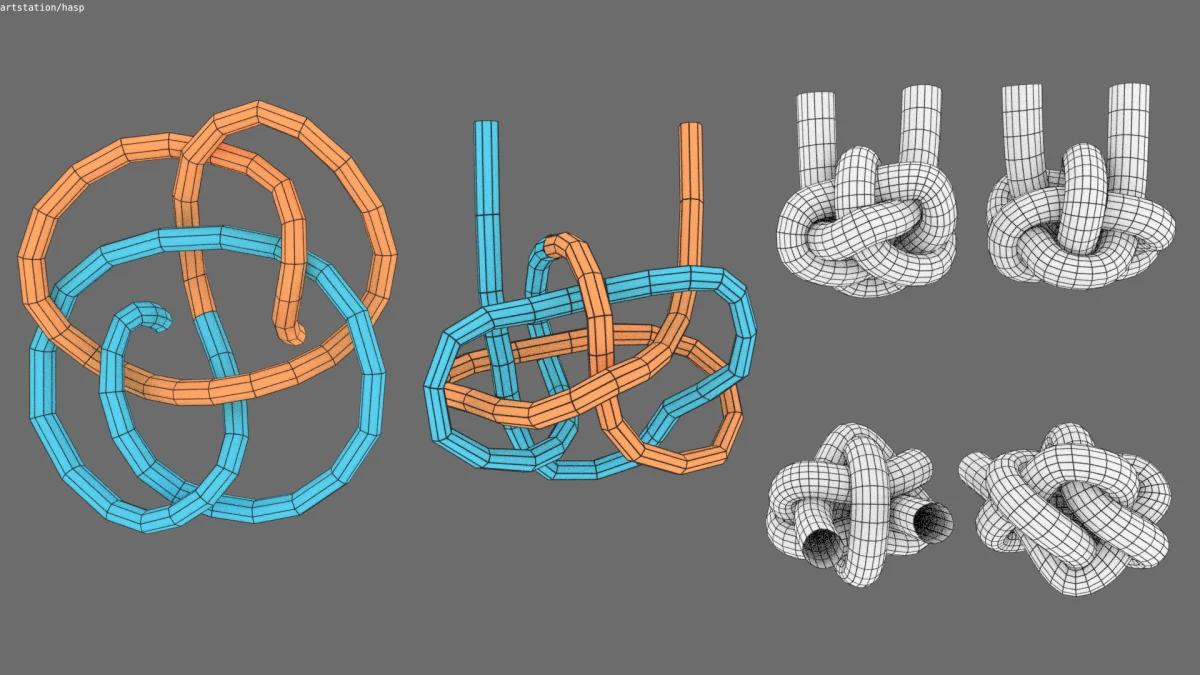
The second image below is Zaripov Rustem’s three-dimensional rendering of a Chinese button knot, identified by its creator as ABOK 599. A rendering can clarify volume and cord paths, but it is not a photograph of an antique garment or evidence that a particular community used that exact object.
Compare the broad, repeated layout of the first image with the compact structure shown in the rendering. Ask where each cord enters and exits, which crossings are visible, and which parts disappear behind the knot. Their different appearances are useful for observation; they are not a complete key for identifying an unknown item.

Describe what you can actually see.
Begin with the whole assembly. Note whether the central structure is broad or compact, whether it has projecting loops, and whether a tassel or bead is attached. Do not count the tassel as another knot simply because it is part of the same hanging decoration.
Next follow one visible segment until it disappears beneath another. Stop where the photograph stops giving information. A single front view may not resolve an over-under crossing or a concealed join. Do not mentally invent the hidden back to make a familiar name fit.
Compare left and right, then top and bottom. Approximate symmetry can be a useful observation, but uneven tightening, camera angle and wear can change the outline. Symmetry alone cannot establish the tying sequence, maker or date. Rotation may also make the same structure appear unfamiliar.
Finally examine the connections: does a loop belong to the central pattern, suspend the whole ornament, or connect an added part? A visible connection suggests a question, not a guarantee of strength. A photo cannot establish whether an old cord is secure enough to handle or hang.
A useful note might read: “A broad cord ornament with repeated crossings and projecting loops; the back and fibre are not visible.” That description can remain accurate even when a named identification must stay uncertain.
Place the ornament in a setting.
The student project describes hanging decorations near New Year as well as gifts and clothing adornments. These are examples, not obligations for every household. When visiting a workshop or receiving an ornament, ask the maker or host how they describe its intended setting rather than assigning one meaning to all red cord objects.
A gift can express a relationship or an occasion without functioning as an instruction about belief. If an ornament comes with a maker’s label, preserve the name and explanation as attributed information. A seller’s description is not automatically a history of the pattern, and a symbolic wish does not establish an effect on events.
Knot imagery also appears in other materials. The Met’s Saddle Rug with “Endless Knots” is catalogued as a nineteenth-century Chinese textile. A knot motif represented in a rug is a different question from a freestanding decorative knot made from cord. Keep the object type, material, recorded date and motif description together when comparing them.
A modern cord ornament cannot be dated by resemblance to an older motif. Nor does resemblance prove that two objects had the same religious or social function. Documented context matters more than how confidently a picture seems to match a familiar outline.
A name is a starting point.
Chinese names, romanized spellings and English pattern names may differ between makers, books and collection records. “Endless knot” can refer to an image or motif as well as to an explanation of a cord form. Keep the source’s exact name beside a plain visual description so another reader can check what you mean.
When a label is uncertain, ask for a clear front and back view, the maker’s name for the pattern and a reference to the lesson or catalogue being used. A second view can answer a structural question that colour cannot. If that evidence is unavailable, an unresolved identification is more useful than a specific but unsupported name.
Red string and Chinese knotting overlap as materials or appearances, but they are not interchangeable topics. Our red-string article discusses a separate set of stories and contexts. A red cord with a knot does not by itself establish a particular relationship narrative, ceremony or protective purpose.
Read the red-string article · Read claims in cultural context
Try a careful comparison.
Use the two credited images rather than an unlabeled search thumbnail. For each, write down the source’s name, the medium of the image, the visible central form and one unanswered question. For the photograph, a question could concern its hidden reverse. For the rendering, ask which parts show explanatory construction rather than a finished physical object.
Then compare the same feature across both images: outer loops, volume or entry and exit paths. Avoid comparing a visible front in one image with an imagined back in the other. This keeps your description anchored to evidence instead of turning a name into a visual shortcut.
If you attend a class, ask permission before photographing the maker’s work or sharing a pattern. Record the teacher’s explanation and credit the demonstrated design. A source image’s permission does not extend to unrelated workshop photographs or instructions.
The practical conclusion is simple: identify the evidence before identifying the knot. Material, crossing sequence, finishing and intended occasion belong together, but none can be reliably supplied by colour alone.
Keep useful questions open.
Is every red hanging ornament one knot? No. Look for an assembly of structural and decorative parts, and ask which name belongs to the centre rather than the entire object.
Can symmetry establish a pattern name? No. It helps describe a visible arrangement, but hidden crossings and different finishing choices still matter. Compare documentation and more than one view.
Does an endless-knot motif prove that a rug was made by tying one decorative cord? No. The represented motif and the textile’s construction are separate matters. Read the museum’s material record.
Where should I continue? Read the red-string guide for the separate question of relationship imagery, or the cultural-context guide to practise distinguishing a visible feature from an attributed interpretation. For a named tying method, follow a complete, credited demonstration rather than trying to infer missing steps from these images.
Read the red-string article · Read claims in cultural context
Sources and context
Source pages read on 2026-11-03. A student project is explicitly distinguished from institutional research. Its inconsistent dynasty/date field and broad origin, homophone and efficacy claims are not repeated here. No continuous invention timeline is asserted.
- Chinese Knotting 中國結 — CCCH9051 Group 64, HKU-hosted student project
Contemporary decoration, gift and clothing examples; student work, not a university institutional finding. Its inconsistent historical date and broad symbolic claims are not adopted.
- Saddle Rug with Endless Knots — The Metropolitan Museum of Art
A dated textile object distinguishes knot imagery from a freestanding cord ornament.
- Pan Chang knot.jpg — YWang9174 / Wikimedia Commons
Creator identifies an eight-row Pan Chang knot with overlapping ears; CC BY-SA 4.0.
- Chinese button knot.png — Zaripov Rustem / Wikimedia Commons
Creator describes a 3D render of ABOK 599; CC BY-SA 4.0. Not a photograph or historical object.
Image credits and licence links apply to the particular works shown, not to every knot pattern. The resized WebP adaptations retain CC BY-SA 4.0. Source descriptions are attributed rather than presented as independent physical examination.