
Cinnabar: material, colour and cultural use
A red mineral, an artist’s pigment and a name on a lacquer label can point to related histories without identifying the same kind of thing.
This is a cultural introduction, not a safety certificate, purchase recommendation or guide to using mercury-containing materials.
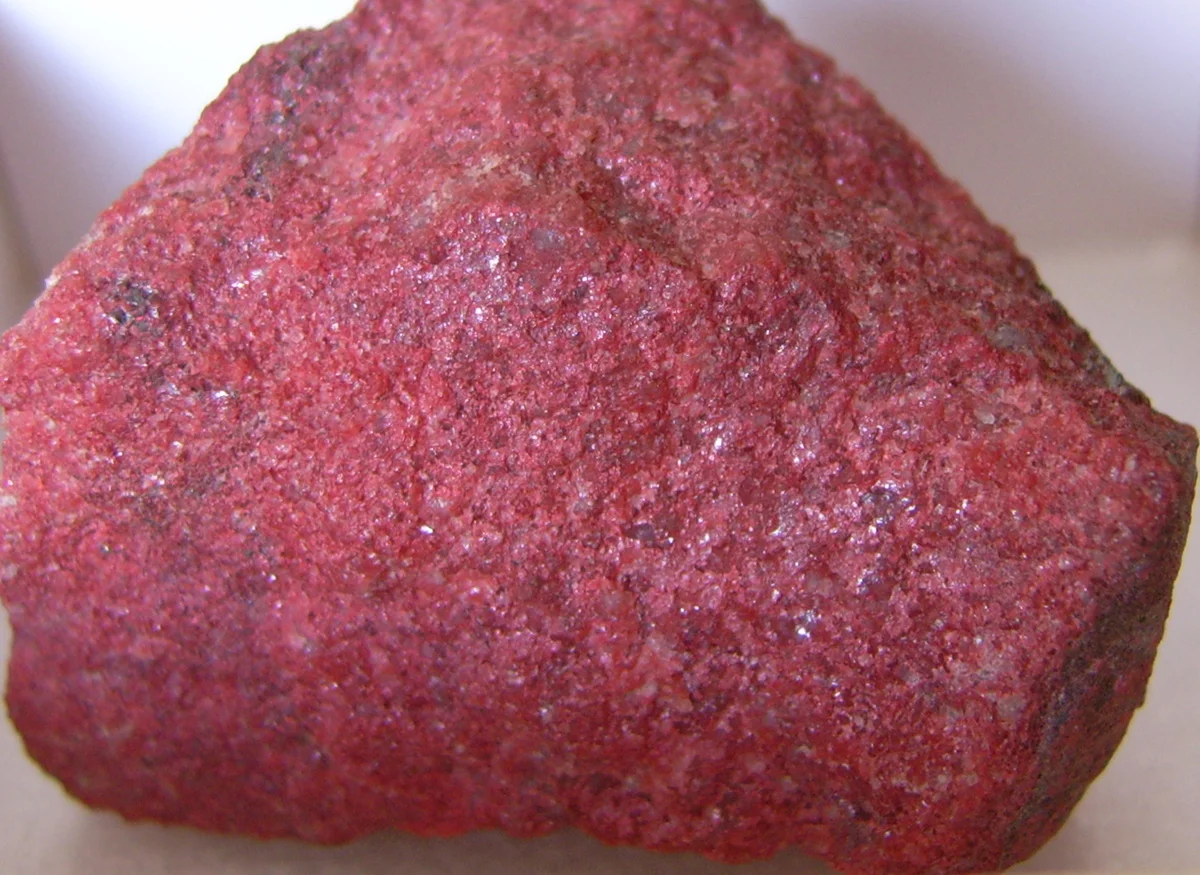
A red cinnabar mineral specimen. The photograph illustrates the material, not a safety assessment or a test for identifying another object.
Shinichi / Wikimedia Commons · Public domain

Begin with the kind of claim.
Cinnabar, called 朱砂 (zhūshā) in Chinese, is a mercury sulfide mineral, commonly represented as HgS. A mineral name describes a material. A colour word describes an appearance. A museum’s medium description describes the documented components of an object. Moving between those categories without checking the evidence can turn a useful name into a misleading promise.
- Cinnabar: the mineral
- The natural mineral is the material reference. A red appearance alone does not identify it.
- Vermilion: the pigment
- CAMEO describes vermilion as synthetic red mercury sulfide, chemically identical to cinnabar. The Met’s essay also uses the term for pigment more broadly. Terminology varies across historical and modern sources; preserve the source’s wording rather than assuming a name proves natural origin.
- “Cinnabar” lacquer
- In an art label, the name can refer to red lacquer associated with this pigment. It does not mean that the whole object was carved from a mineral block.
- A modern commercial name
- A label, photograph or stated percentage is a claim requiring its own documentation. It cannot establish composition, provenance or safety by itself.
When taking notes, write “the catalogue describes…” before the material term. That keeps a documented description distinct from your own visual guess.
Red is part of an object’s history.
The Met’s 2009–2010 carved-lacquer exhibition explains that cinnabar was among the mineral colorants used in Chinese lacquer. Its overview describes carving the lacquer layers over a support, usually wood. The important distinction is between the coloured surface and the object’s underlying structure: a red carved box is not automatically a carved lump of cinnabar.
The exhibition’s thirteenth- to eighteenth-century examples include containers for different purposes. Their material, decoration and function belong together. A vessel’s historical role does not establish that a contemporary object with a similar colour has the same composition or should be put to the same use.
For interpretation, ask what a particular record actually connects: a date, place, maker, use or design. Do not turn the colour red into one explanation for every period or community. Cultural associations are interpretations situated in records and practices; they are not evidence that a substance produces protection, healing or good fortune.
One caption, more than one material.
Ellen Spindler’s 2018 Met essay reproduces a Chinese Shang-dynasty comb dated to the thirteenth–eleventh century BCE. Its caption identifies jade (nephrite) with traces of cinnabar, accession 1985.214.94. This is a useful reading exercise: the comb’s base material and the reported pigment traces are different parts of one description.
The caption does not call the comb a solid cinnabar object. Nor does it make an unidentified red mark on another object cinnabar. The article is the source for this example; we have not physically examined the comb or performed an independent analysis. Follow the museum record for its current catalogue information.
Try separating a label into four notes: object type, base material, surface or residue, and the record that supports each statement. Leave a blank when the record does not answer a question. This is an editorial reading method, not a home identification test. For comparison, read our nephrite and jadeite reference without transferring its conclusions to an unknown object.
A product label cannot replace material evidence.
Words such as “natural,” “traditional,” “cinnabar red” or a claimed mineral percentage may sound precise while leaving important questions unanswered. What component is being named: a pigment, coating, filler, composite or the whole object? Which document describes that component, and does it refer to this particular item?
Those are questions for evidence, not buying instructions. This guide does not authenticate products, rank sellers, set a purity threshold or recommend wearing an object. It cannot establish that a particular item is mercury-free, safe for skin contact, suitable for food contact or appropriate around children. A museum object’s historical existence is not a modern product certification.
Photographs can help document appearance, but colour and carving style cannot settle chemical composition. Do not scratch, break, burn or apply chemicals to an object to test a label. For a collection item, ask a qualified conservator or relevant materials specialist how to document the question without damaging it or creating exposure.
Historical use is not permission to use it now.
WHO distinguishes elemental, inorganic and organic forms of mercury and explains that their toxic effects differ. Its general fact sheet cannot calculate the risk of a particular lacquer box, powder or composite. Amount, material form and route of exposure matter; an online cultural article cannot assess your individual situation.
CAMEO includes ingestion, inhalation and skin absorption in its vermilion hazard entry. We therefore do not infer safety from a mineral’s natural origin or its historical use. Equally, we do not treat seeing a museum object or a red photograph as proof that a harmful exposure has occurred. A material hazard and an assessment of an actual exposure are different questions.
Do not ingest cinnabar or use it as a medicine, cosmetic or body preparation on the basis of this article. We provide no dose, processing recipe, heating or grinding procedure, home test, treatment or detoxification instructions. We do not recommend experimenting with unknown powders or damaging an object to investigate its contents.
If there is an actual or suspected exposure, contact a qualified health professional or your local poison information service for advice specific to the material and circumstances. For an urgent medical emergency, use your local emergency service. This page cannot diagnose poisoning, judge a safe exposure level or replace that consultation. For a damaged or deteriorating collection object, seek qualified conservation guidance rather than attempting a repair yourself.
Keep the useful questions separate.
Does “cinnabar” always mean a mineral object?
No. Read whether the record describes the mineral, a pigment or lacquer. Ask what the evidence identifies and where uncertainty remains.
Does a historical use show a benefit from wearing it?
No. Documenting an earlier use or belief is not evidence of health effects, spiritual efficacy or a present-day recommendation. This guide makes none of those claims.
Can this page tell whether an item I own is safe?
No. Keep the object’s documentation and your actual question together, and consult the relevant professional. A composition question, conservation question and possible exposure concern may require different expertise.
The useful conclusion is modest: learn to read the material name, the object’s construction and the evidence independently. You can understand the cultural history without reproducing historical practices or treating a modern label as a guarantee.
Sources and context
Sources consulted on 2026-11-01. Museum sources support attributed terminology and historical examples. WHO supplies general mercury-health context, not an object-specific ruling. We omit manufacturing instructions even where a source includes them.
- Comb, 1985.214.94 — The Metropolitan Museum of Art
Current object record: nephrite with traces of cinnabar, Shang thirteenth–eleventh century BCE; image explicitly Public Domain.
- Vermilion — CAMEO, Museum of Fine Arts Boston
HgS pigment terminology and hazard context; no manufacturing procedures reproduced.
- Cinnabar: The Chinese Art of Carved Lacquer — The Metropolitan Museum of Art
2009–2010 exhibition overview: pigment-coloured lacquer and carved layers over a support, not a mineral-carving identification rule.
- The Story of Cinnabar and Vermilion (HgS) at The Met — The Metropolitan Museum of Art; Ellen Spindler, 2018
Terminology, global historical contexts and the Shang comb 1985.214.94 caption; no claims about unexamined modern objects.
- Mercury — World Health Organization, 24 October 2024
Different mercury forms and exposure routes require distinction; general health concern, not an object-specific exposure assessment.
Browse the guides · Read what hardness can and cannot establish · Suggest a documented correction