
Chinese lanterns: materials, light and everyday settings
Look closely at Chinese lantern frames, painted surfaces and lighting, from household surname lanterns to festival streets and public installations.
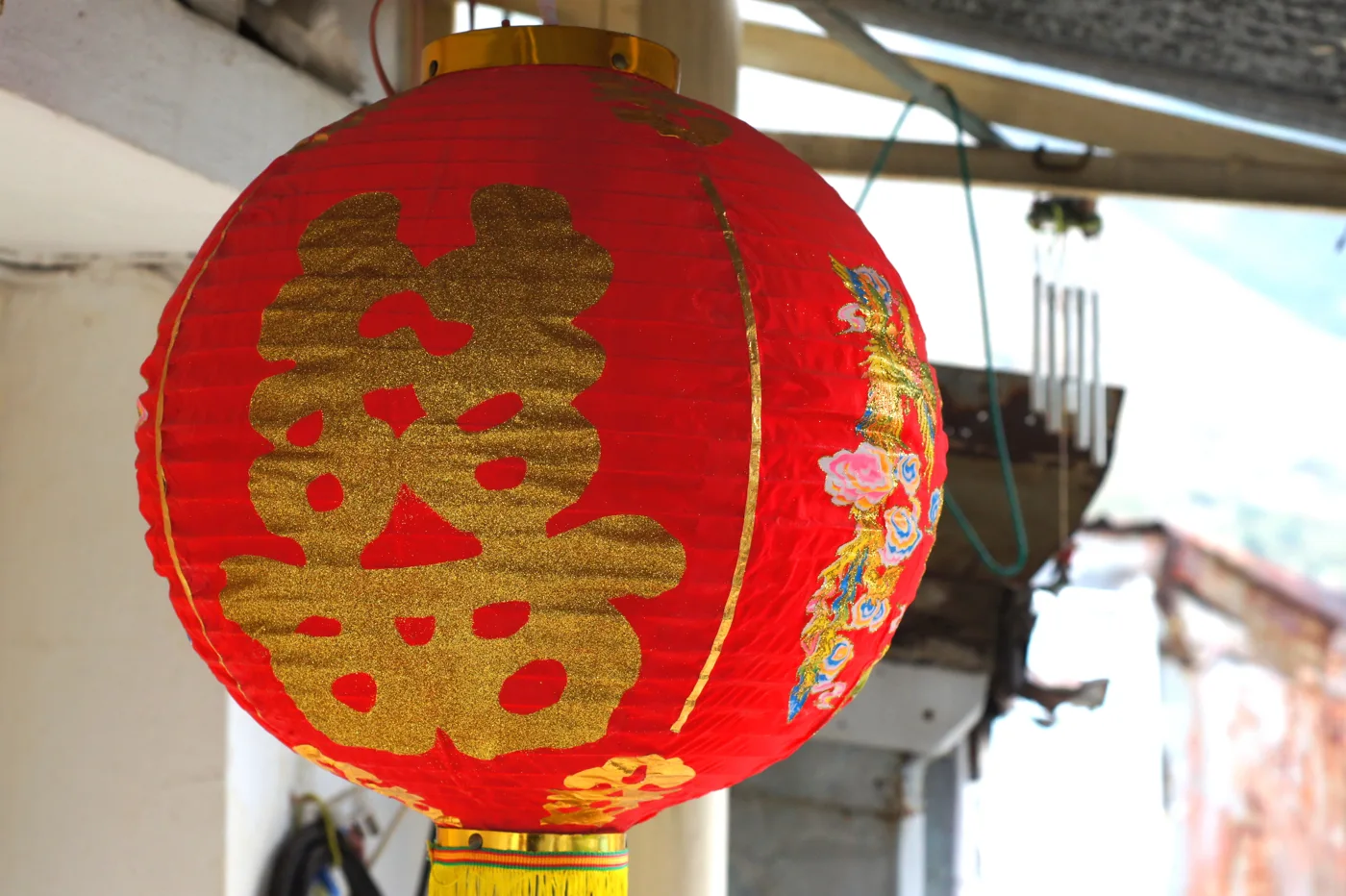
Decorative lantern with double-happiness design, photographed 2 January 2012; the photograph does not document a particular wedding. Resized to WebP without cropping or recolouring; adaptation distributed under CC BY-SA 3.0.
Mk2010 / Wikimedia Commons · CC BY-SA 3.0 · Image adapted for display.

Start with the lantern in front of you.
A Chinese lantern can be a light source, a painted object, a household sign or part of a public spectacle. The familiar red globe is one form among many. Look first at its outline and its surroundings: a single hanging object invites a different encounter from a street covered with repeated rows. A lantern photographed in daylight may reveal its ribs clearly, while the same object illuminated at night can appear to be a continuous field of colour.
This guide follows specific examples from Singapore, Hong Kong and museum collections. Together they offer ways to read materials, images and uses without treating every lantern as a decoration for one festival. For a first look, ask two questions: what holds the shape, and what is the object doing here? A visible frame answers part of the first question. A doorway, an inscription or a dated event caption may help answer the second.
Keep those questions separate as you look. A photograph of a red lantern cannot establish its maker, its age or the occasion for which it was hung. It can still show the relationship between a rounded surface and its ribs, the placement of lettering, or the way a tassel extends the silhouette below the body.
The frame gives light a surface.
Singapore’s National Heritage Board identifies bamboo frames and oil-coated silk paper as basic materials in its account of traditional lantern making. Its 2022 craft showcase also describes painted characters, motifs and family surnames. These are descriptions of a documented craft practice; a lantern sold today may use a different covering or support. A useful material description distinguishes the frame from the skin instead of calling the whole object “paper.”
In a close view, follow a rib from top to bottom. Does the surface stretch smoothly between supports or gather into folds? Where does a painted line cross a rib? These observations help explain how structure participates in the image. A dark line may belong to the supporting frame, to painted decoration, or to a shadow. Check another part of the photograph before deciding which.
Hong Kong’s Intangible Cultural Heritage Office places lanterns within a wider paper-crafting practice that also uses coloured papers and silk fabrics. This broader context helps explain why a lantern can share workshop skills with quite different festive objects. The finished silhouette alone may conceal that shared labour. A craft photograph showing an unfinished frame can tell a story that a fully lit display cannot.
Round is only a starting point.
The Roots heritage account distinguishes Teochew and Foochow lanterns in Singapore. It names oval and persimmon shapes among Teochew forms and an umbrella lantern among Foochow forms. Its practitioner account describes a cylindrical Foochow frame with an internal arrangement that allows collapse, while the Teochew frame supports itself. These local distinctions give shape a more specific vocabulary than “traditional Chinese lantern.”
Use a type name when the maker or catalogue supplies it. For an unlabelled example, describe the visible shape in ordinary words: tall cylinder, flattened globe, faceted body or projecting roof. That description remains useful even while the exact name is uncertain. It also gives someone looking at the object another way to check your identification.
Compare the top and bottom as carefully as the broad middle. A suspension loop, an opening and a fringe belong to different parts of the design. A collapsed lantern may look like a stack of coloured bands; an expanded one reveals the volume those bands enclose. Museum photographs and display photographs therefore answer different questions about an object’s form.
Illumination changes what you can see.
National Museums Scotland’s learning resource describes the lantern’s initial purpose as providing light. Its pictured modern examples include collapsible red forms. The resource is useful for separating a practical function from the many decorative roles an object can acquire. A lantern may remain meaningful as an ornament even when its light is switched off.
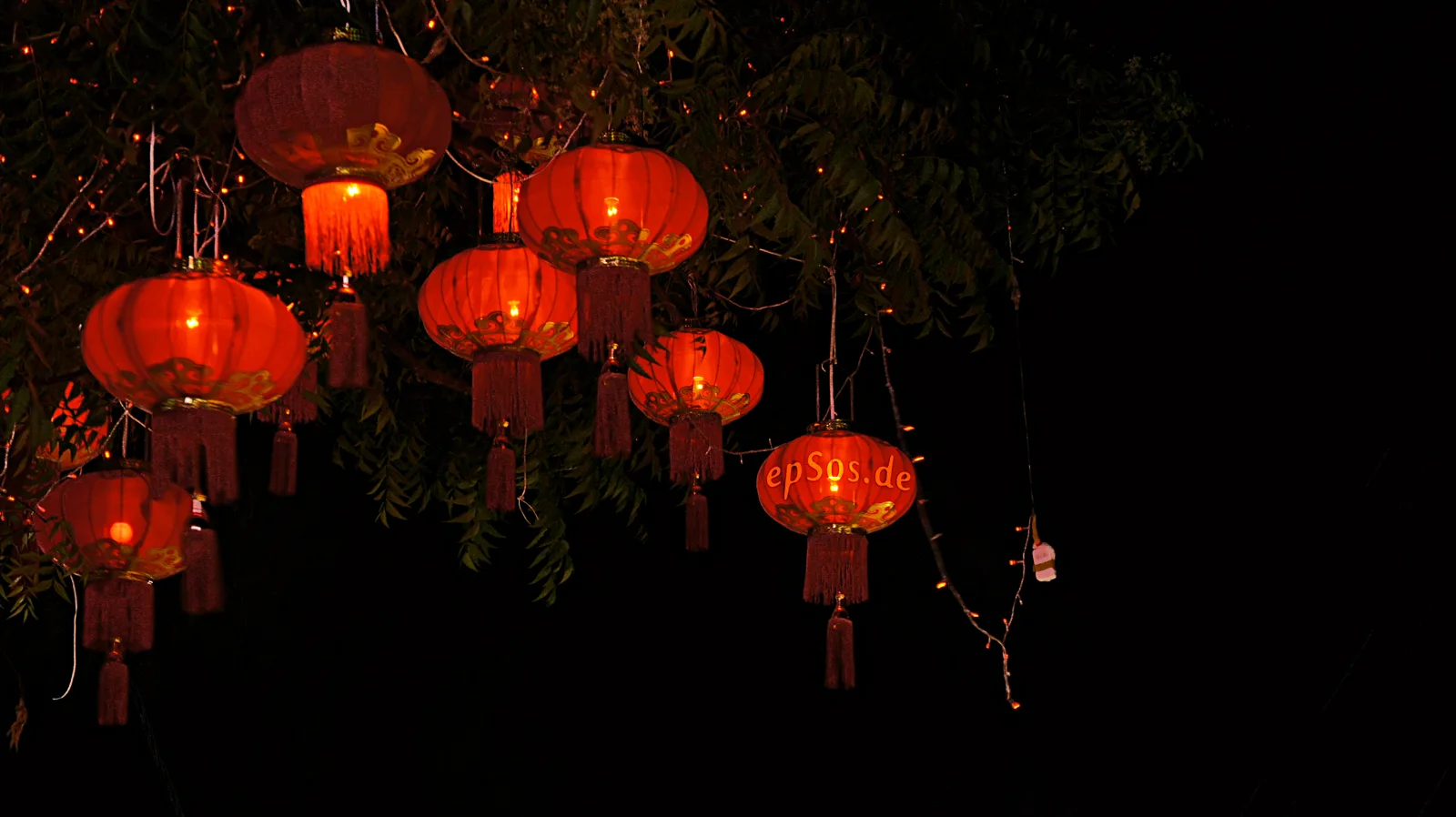
Look at the night photograph below with that distinction in mind. The illuminated red bodies stand out against darkness, while their thin supports and suspension lines are less prominent. This is an observation about the photograph, not a test of its brightness. A camera’s exposure changes the apparent balance between a glowing object and the surrounding street. It cannot tell us how easily a person standing there could read.
A historical reference to candlelight also does not identify the lighting system in a modern photograph. Hong Kong’s 2017 heritage exhibition offers a documented example of change: Chan Yiu-wah made three large rotating lanterns based on palace-lantern designs, with electric machinery at their central axes. Traditional craft and electrical movement belonged to the same installation. The event record describes that particular work; it does not supply a construction recipe.

Read the painted surface.
The cover close-up shows a decorative lantern with a double-happiness design, as identified by its photographer. Notice how the large character sits on a curved, ribbed field. From one viewpoint part of the surface turns away, so the visible image is only a portion of the whole object. Walking around a lantern can reveal details that a frontal picture compresses or hides.
An inscription may name a family, carry a wish or identify an occasion. Transcribe what is visible before supplying an interpretation. If only half a character survives in the photograph, preserve that uncertainty. A red surface and a festive-looking character provide clues, but the photograph’s title does not identify the people who owned this example or an actual wedding at which it was used.
The same care applies to painted animals and flowers. Begin with their arrangement: a single large image, several framed scenes, or repeated motifs around the body. A separate guide can explore an identified motif in detail. The immediate task here is to see how lettering and ornament occupy a surface designed to be suspended and viewed from more than one direction.
A doorway can carry a family name.
The Peranakan Museum’s Pair of lanterns record describes a cylindrical lantern bearing the household surname. Its material listing is bamboo and cotton. The museum explains surname lanterns in relation to Peranakan Chinese families, festive display, ancestors and family roots. This gives us a household context beyond the idea of an anonymous red street decoration.
A surname changes the question a viewer asks. Instead of asking only which festival is being celebrated, one can ask who is represented at this threshold. The doorway places a named household in relation to people approaching from outside. To interpret a particular pair, retain the museum label or the family’s explanation; an unfamiliar name should not be turned into a guessed genealogy.
Everyday surroundings also matter even when an object is brought out for a special occasion. A lantern beside a residential entrance, one above a shop and one inside a museum occupy different settings. Note which setting the image actually shows. A collection photograph documents the surviving object, while evidence for its former position or use comes from the accompanying record.
Several occasions share the lantern.
Lantern Festival, or Yuanxiao, falls on the fifteenth day of the first lunar month. National Museums Scotland associates its celebrations with lantern viewing and riddles, as well as tangyuan. Our Lantern Festival guide follows that calendrical occasion in more detail. A lantern’s presence elsewhere in the year is not evidence that this festival is taking place.
The National Heritage Board’s Singapore craft showcase names Mid-Autumn, deities’ birthdays and weddings among lantern settings, as well as places of worship and clan associations. These contexts invite different questions. A wedding commission may speak to a particular household; an association’s display may address a larger community. The object’s date, location and inscription help determine which account belongs to it.
Public displays introduce another scale. Ask whether the photograph shows a portable lantern, repeated street decorations or a purpose-built installation. The comparison below gives named examples and dates so that a household object does not disappear into a general category of “festival lights.” Historical event photographs illustrate those events as recorded, rather than announcing a programme for this year.
One lantern, three different settings
Start with where the lantern sits and who uses it. A light in a family celebration, a row of decorations and a large public installation can share a name while asking very different things of their makers and viewers. These located examples help you read a scene without treating every lantern as the same festival symbol.
A household object: one family’s light
Singapore · a childhood recollection recorded by the National Heritage Board
In the Roots account of Mid-Autumn, Madam Au Yue Pak remembers her family lighting a single lantern when she was a child. The recollection places it beside prayer to the Moon Goddess, food offerings and a family meal. It gives us an unusually small scale to consider: one lantern within the life of one household. It is a remembered practice, with no exact childhood year supplied, rather than a dated survey of Singapore homes.
For a reader comparing lanterns, this changes the first question. Instead of asking how spectacular the object looks, ask what it did in that gathering. Was it carried, placed near the meal or hung where people met? The recollection establishes the family context; it does not describe every material or provide a complete account of where the lantern stood. A photograph of another lantern cannot fill those gaps.
If you are choosing a lantern for a room or visiting someone who has one, begin with the owner’s explanation. Ask whether it is a seasonal decoration, a keepsake or something connected with a particular occasion. A red surface or a familiar silhouette is too little evidence to decide that for them. The domestic scale also makes details easy to overlook: a handle, a hanging point and the direction of the light may matter more to use than the overall outline.
National Heritage Board, Singapore — Roots: Mid-Autumn Festival
Festival decoration: a scene made from many objects
Singapore craft contexts · photograph from Victoria Park, Hong Kong, September 2012
The National Heritage Board’s lantern-making record describes hanging lanterns outside Singapore homes, temples and clan associations at Chinese New Year and Mid-Autumn. It also records commissions for other occasions. Its examples show why “festival decoration” is a use, rather than one fixed kind of object: the setting, patron and imagery help explain the choice. A lantern hanging on a building need not have the same role as a child’s carried light.
In the photograph below, a large illuminated child figure carries a pole with smaller lantern forms, while strings of lights and hanging red lanterns fill the background. Compare the individual outlines with the effect of the group. The figure gives the display a focal point; a single small lantern removed from that arrangement would tell you much less about the event. This is a photograph of the 2012 Mid-Autumn Lantern Carnival at Victoria Park in Causeway Bay, Hong Kong. It illustrates a particular public display, separate from the Singapore craft record.
To describe a festival photograph well, keep the event name and location with it. “Chinese lanterns at night” loses information that a reader needs to distinguish a seasonal street decoration from an organised display. Avoid assigning a hidden meaning to every colour in the frame. The visible arrangement supports observations about shape, spacing and illumination; an account from its maker or organiser would be needed to explain the intended programme.
National Heritage Board, Singapore — Roots: Making of Traditional Chinese Lanterns
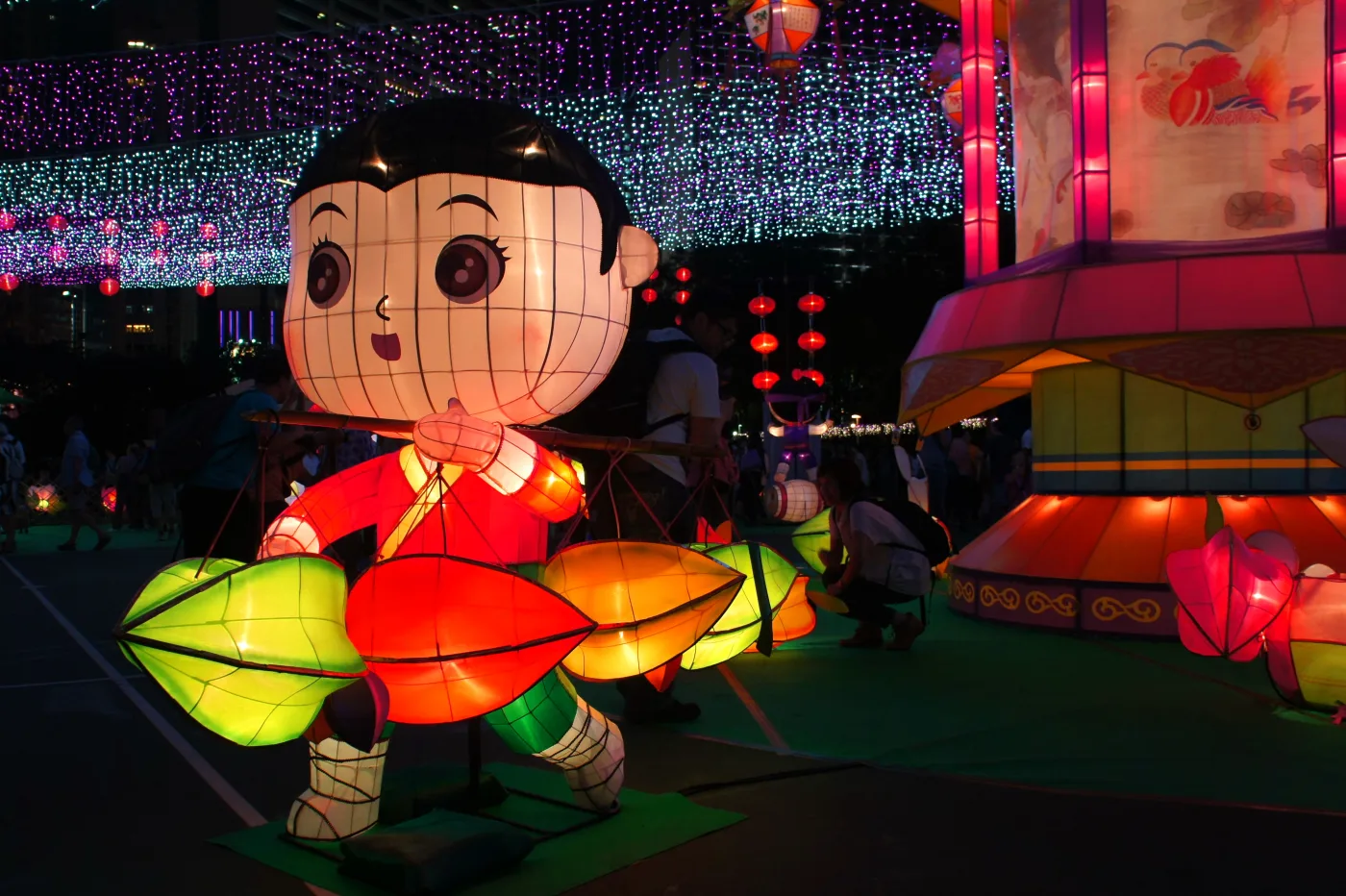
Mid-Autumn Lantern Carnival, Victoria Park, Causeway Bay, Hong Kong; photographed September 27, 2012. This historical display is not a current event listing.
Mk2010 / Wikimedia Commons · CC BY-SA 3.0 · Resized WebP adaptation, shared under the same licence.

A public light festival: the 2017 Taiwan Lantern Festival
Yunlin County, Taiwan · February 2017
Yunlin County Government’s February 11, 2017 announcement describes a festival spread across Huwei and Beigang. It dates the main festival opening to February 11 and the end to February 19, while noting that Beigang had opened earlier. Its central attraction was a 23-metre phoenix-shaped lantern using LED lighting systems. Those details place this example at the scale of an engineered public event, with several sites and a planned programme.
Look at the daytime photograph as well as imagining the night display. A large gateway carries rows of red and yellow lanterns above the visitors below. Daylight lets you see the supporting structure and the scale of the entrance without the glow usually associated with lantern photography. The image was made in Yunlin on February 18, 2017. It documents a view within that edition of the festival; it cannot show every district or establish the exact construction of every installation. The organiser’s description of the main lantern should not be transferred to every object visible in a festival photograph.
When deciding whether two events belong in the same comparison, distinguish their names before comparing their pictures. Taiwan Lantern Festival is the name of this organised event; Mid-Autumn names a different seasonal occasion in the Hong Kong example above. Shared illuminated objects do not make the calendars interchangeable. For a future visit, use that year’s organiser information for the venue, opening hours and access arrangements. The dates here belong to the 2017 record and offer no schedule for 2026 or a later edition.
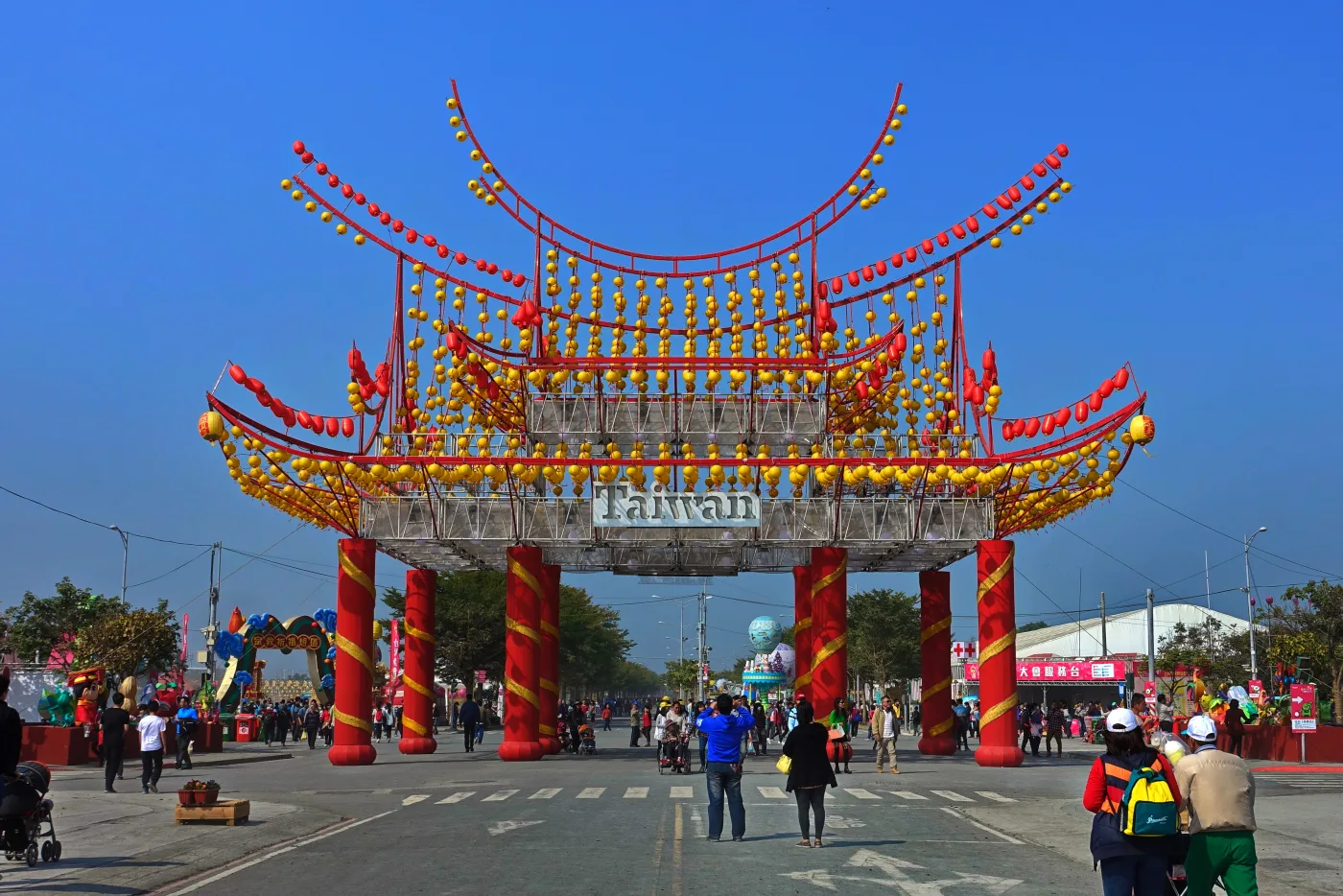
Taiwan Lantern Festival, Yunlin County, Taiwan; photographed February 18, 2017. Daylight reveals a lantern-covered gateway and its supporting structure.
Malcolm Koo (Mk2010) / Wikimedia Commons · CC BY-SA 4.0 · Resized WebP adaptation, shared under the same licence.

Try describing any lantern scene in one sentence with an object, a use, a place and a period. Then ask which of those details came from the image and which came from its caption or a written account. That simple distinction makes comparisons more useful: it preserves what you can see while leaving room for the people who made and used the lanterns to explain the rest.
A lantern can also be a woven image.
The Metropolitan Museum of Art’s Chair Strip with Cranes and Lantern, object 53.166.1, is a seventeenth-century Chinese textile in silk and metallic-thread tapestry, or kesi. Its account explains that lantern-patterned textiles could decorate the annual Lantern Festival. The chair strip extends the subject beyond objects with an actual lamp inside: a lantern could be represented on furnishing fabric.
This distinction is especially useful when searching a museum collection. A result for “lantern” might be a functioning light enclosure, a model, a painted motif or a textile with a lantern pattern. Read the object type and medium before grouping those results together. Their shared imagery can be interesting, but their functions differ.
The Met also interprets the cranes on this textile through associations with longevity, career success and official rank. Those are attributed meanings in a particular catalogue account. Keep them attached to that record when discussing the design. A modern lamp with a bird motif needs its own context before the same interpretation is applied to it.
Take a useful second look.
Try comparing one daylight photograph and one night photograph. In daylight, trace the supports and look for brushwork or printed pattern. At night, notice which parts glow, which remain opaque and how repeated lanterns organise the space. Write down one observation from each image. This small exercise helps separate details of the object from effects introduced by lighting and photography.
For a personal caption, keep the essentials together: the supplied name, the place shown, the date of the photograph and the source. Add the material only when a record identifies it. “Red lanterns at night” may be an accurate caption when nothing more is known; a confident festival name would add an unsupported story. Photographs can be visually rich while retaining a modest caption.
For a contemporary decoration, record the maker’s stated materials and intended lighting system if available. Museum objects offer comparisons of form and use, but they cannot authenticate an unrelated purchase. Readers interested in the calendar can continue to Lantern Festival; those following painted motifs can explore Chinese dragon imagery. Each route begins with a different question about the same visible surface.
Questions about lanterns
- Are all Chinese lanterns paper?
- No. Records here distinguish bamboo frames, paper coverings and a museum pair made with cotton. Identify the support and covering separately, using the maker or collection record.
- Are lanterns only used at Lantern Festival?
- No. The documented settings here also include Mid-Autumn, weddings, places of worship, clan associations and household surname display.
- Does a red lantern photograph identify a festival?
- Colour alone does not identify the occasion. Look for a dated caption, location and information from the maker, household or event organiser.
Sources and image credits
The linked museum and heritage records supply the named examples and interpretations. Past exhibition dates describe those recorded events.
- Making of Traditional Chinese Lanterns — National Heritage Board, Roots
Singapore regional forms and practitioner account; October 2019 inventory entry, updated 2020.
- Craft × Design showcase, Annex B — National Heritage Board
2022 craft account: bamboo frames, covering, painted motifs and social settings.
- Paper Crafting Technique — Hong Kong Intangible Cultural Heritage Office
Materials and wider festive paper-crafting context.
- Traditional Craftsmanship of Lantern Making, 2017 — Hong Kong Intangible Cultural Heritage Office
Chan Yiu-wah’s three electrically powered rotating palace-lantern installations; past event.
- Pair of lanterns — Peranakan Museum / National Heritage Board, Roots
Bamboo and cotton; household surnames and Peranakan family context.
- East Asia: Traditions and Celebrations, p. 17 — National Museums Scotland
Lantern function and Lantern Festival classroom context.
- Chair Strip with Cranes and Lantern, 53.166.1 — The Metropolitan Museum of Art
Seventeenth-century kesi textile, lantern motifs and attributed crane associations.
- Red Chinese Lanterns at Night — epSos .de / Wikimedia Commons
Photograph, 1 February 2012; CC BY 2.0.
- Double Happiness Lantern — Mk2010 / Wikimedia Commons
Photograph, 2 January 2012; CC BY-SA 3.0.
- Mid-Autumn Festival — National Heritage Board, Singapore — Roots
A named practitioner’s family recollection and Singapore Mid-Autumn practices.
- A grand debut demonstrating integrations of technology and tradition at the 2017 Taiwan Lantern Festival in Yunlin — Yunlin County Government, February 11, 2017
Historical festival announcement: Huwei and Beigang districts, dates and the main illuminated sculpture.
The night photograph is by epSos .de, CC BY 2.0; the double-happiness cover is by Mk2010, CC BY-SA 3.0. Both were resized and converted to WebP without cropping or recolouring. Scene photographs carry their own credits beside the images.