
Bagua: eight trigrams and the yin–yang diagram
Read the eight trigram line patterns, compare bagua with the yin–yang symbol, and place diagrams in their textual and object contexts without fortune-telling.
The diagrams are editorial reading aids; this guide offers no personalized readings or predictions.
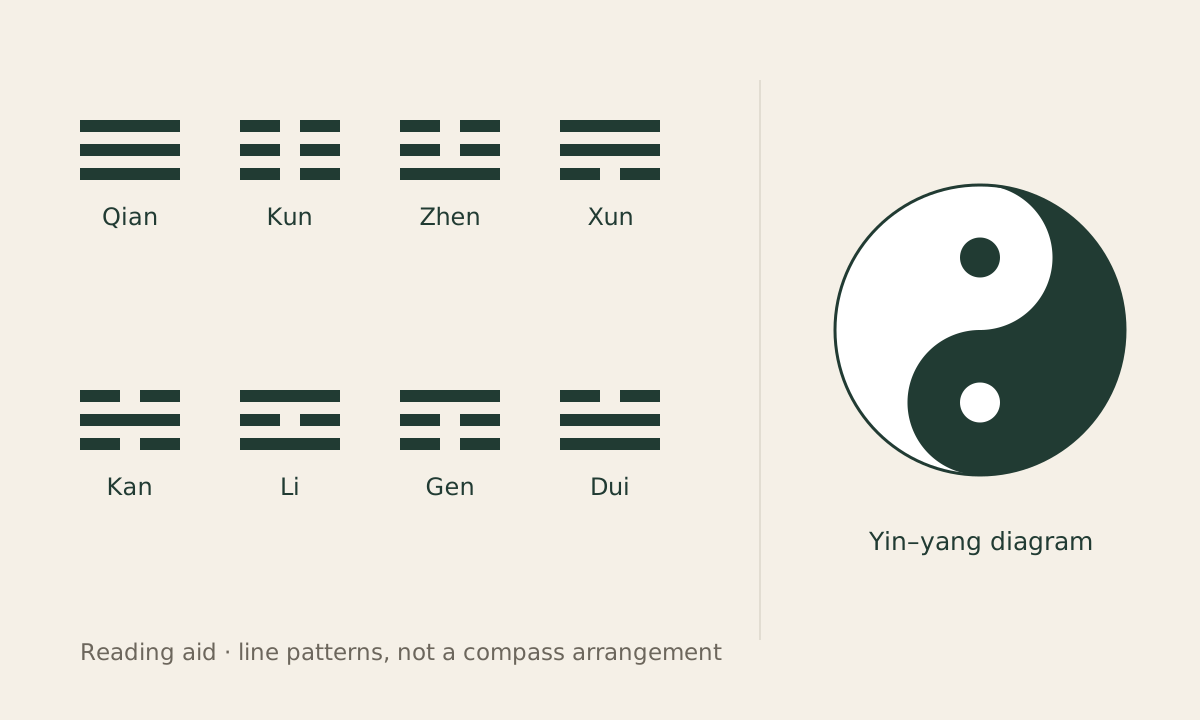
Eight trigram patterns beside a familiar yin–yang circle. This two-row index is an editorial reading aid, not a compass arrangement or historical facsimile. Full line descriptions and a sourced circular arrangement follow below.
OrientLore original editorial diagram; structure references in the guide · Original editorial diagram
Three lines make a trigram.
Bagua, 八卦 (bāguà), names the eight trigrams: eight different combinations of three horizontal lines. Each line is either unbroken, conventionally called yang, or broken into two parts, conventionally called yin. A broken line still counts as one line. Counting its two visible strokes as two separate lines is an easy way to misread the figure.
Read the stack from bottom to top. In the line descriptions below, the first word always describes the lowest line. Two choices in each of three positions produce eight patterns: 2 × 2 × 2 = 8. This is a way to understand the graphic structure, not a claim that the system originated as modern computer notation.
A trigram has three lines; a hexagram has six. Two trigrams can be stacked to form a hexagram, with one below and one above. The same name may occur in discussions of either, so check how many lines the source actually shows. Eight trigrams and sixty-four hexagrams are related collections, not interchangeable names for one diagram. See Hon’s accessible line descriptions for the convention used here.
Learn the pattern with the name.
These common natural-image labels are a starting vocabulary, not a complete dictionary of the trigrams’ meanings. Read Heaven, Earth or Water as an attributed symbolic association in a textual tradition, rather than as a physical ingredient in the printed sign. The figures are drawn with SVG so their lines do not depend on your device having a specialist symbol font.
Qian 乾
Heaven
Bottom to top: unbroken, unbroken, unbroken.
Kun 坤
Earth
Bottom to top: broken, broken, broken.
Zhen 震
Thunder
Bottom to top: unbroken, broken, broken.
Xun 巽
Wind
Bottom to top: broken, unbroken, unbroken.
Kan 坎
Water
Bottom to top: broken, unbroken, broken.
Li 離
Fire
Bottom to top: unbroken, broken, unbroken.
Gen 艮
Mountain
Bottom to top: broken, broken, unbroken.
Dui 兌
Lake
Bottom to top: unbroken, unbroken, broken.
For example, Zhen has an unbroken lowest line and two broken lines above it. Gen reverses that vertical pattern: two broken lines below an unbroken top line. Xun has a broken lowest line and two unbroken lines above. A quick glance at the total number of solid strokes would miss those distinctions. Keep the orientation and the line order in your notes.
Spellings vary between publications. The SEP appendix prints “Sun” for Xun and “Zheng” for Zhen; this guide uses Xun and Zhen consistently, alongside the Chinese characters. Translation also varies: Dui’s image can be rendered lake or marsh. A different English word does not necessarily indicate a different line pattern.
A circle needs a reference.
The following ring follows the positions in SEP Appendix 1’s linked diagram. Start at the top and move clockwise: Kan, Gen, Zhen, Xun, Li, Kun, Dui, Qian. We redraw each trigram upright to make its three-line pattern easy to read; the source rotates the signs around the ring. The position and the orientation of a sign are separate choices.

You may encounter the names Earlier Heaven (xiāntiān) and Later Heaven (hòutiān) when comparing bagua diagrams. Do not assume every ring has the same placement, or that the top of every printed image means north. For a particular chart, record its source, arrangement label, stated directions and how the signs are oriented. If those details are missing, leave them unresolved.
The ring here is a sourced example, not a declaration of one correct form for all periods. It also is not a house plan. Nothing on this page assigns a room, door or person to a trigram. Historical interpretation and present-day instructions for arranging a home are different kinds of claims.
Related ideas, different structures.
The cover shows two things side by side: the eight three-line figures and a familiar circular yin–yang design. The cover’s two-row grouping is an index, not a circular arrangement. The circle has contrasting interlocking fields, each containing a small dot of the other colour. It has no three-line stacks. Bagua and that circle can appear together without becoming identical.
Bagua: distinguish eight patterns
Look for three-line groups. Identify which lines are broken, read bottom to top, then check each group’s placement if it belongs to a larger arrangement. A central yin–yang circle is not required to recognize the trigrams.
Yin–yang diagram: describe the pictured form
Look for the contrasting fields and their relationship. The two dots belong to this familiar design; they are not additional trigrams. Colour alone is an unreliable identifier when an artist changes the palette. Describe the actual visible structure before interpreting it.
A combined design: read each layer
If eight trigrams surround a yin–yang circle, describe the outer ring and the centre separately. Add the arrangement’s documented name where available. Do not infer a date, religious affiliation or intended use solely from that combination.
“Taijitu” means a diagram of taiji, a term translated in different ways, including Supreme Polarity and Great Ultimate. It does not name only one unchanging graphic. Joseph Adler’s presentation of Zhou Dunyi includes a vertically organized historical diagram, visibly different from the simple two-field circle drawn here. That comparison is a useful reminder to consult the particular image and accompanying text rather than attach a modern icon to every occurrence of the word.
Robin R. Wang’s discussion of yinyang emphasizes interaction and changing relationships. Reducing the contrasting fields to “good versus evil” loses that philosophical context. These are interpretive traditions, not a colour-coded ranking of people. A diagram on a shirt likewise cannot tell you the wearer’s beliefs or intentions.
Read the setting as well.
A text and its commentaries
The Yijing, also called the Book of Changes or I Ching, has graphic, textual and interpretive layers. Hon’s introduction distinguishes traditional origin accounts from the text’s layered history and later readings. A traditional association with the culture hero Fuxi should be labelled as attribution, not presented as an independently established invention date.
A named museum object
The Met records a Chinese Tripod bowl with Eight Trigrams (Bagua), accession 91.1.280, as 19th-century Qing stoneware with flambé glaze, or Shiwan ware. Here a symbol belongs to a ceramic object with its own date and medium. The record supports that specific identification. It does not establish what every owner believed, or how every similarly decorated bowl was used.
A contemporary design
When a modern illustration, ornament or logo uses the trigrams, separate what you can see from what its maker documents. “Eight three-line signs around a circle” is a visual description. “Made for this community’s ceremony” needs evidence about that object. Claims of protection or predictive power require a different kind of evidence; the presence of a historic symbol does not establish such effects.
Philosophical discussion, religious practice, divinatory history and decoration can overlap, but one word does not explain every instance. Ask who made the item, for whom, when and with what stated purpose. Keep an unknown purpose unknown instead of replacing it with the most familiar story.
Make a caption you can defend.
Try a small reading exercise using the sourced ring above. First count the groups: eight. Then choose the sign at the top. It has a broken bottom line, an unbroken middle line and a broken top line, so the pattern is Kan. Finally, record where that placement came from: the linked SEP appendix, redrawn upright for this guide.
A defensible caption would be: “Editorial diagram of eight trigrams in the positions shown in SEP Appendix 1, with upright signs.” It would not say “the original ancient bagua” because the reference does not establish that claim. Nor would it call the blank centre a missing yin–yang symbol: the trigrams are readable without one.
Now repeat the exercise with the Met bowl record. Keep three fields separate in your notes: what the catalogue calls the object, what the record says about date and material, and which questions remain open. You do not need to decode every mark to make an accurate note. Follow a museum’s updated record when it differs from an older caption.
For an unfamiliar image, save its source and orientation before sharing an explanation. If you cannot confidently count the lines, say so. That modest step is more useful than adding an elaborate interpretation to a reversed or incomplete sign.
Keep the next question specific.
Is every octagon a bagua?
No. An eight-sided outline alone does not show the eight trigrams. Look for the line groups and the object’s documentation.
Is the yin–yang circle a ninth trigram?
No. It is a different graphic structure. A design can combine a centre and an outer ring, but the centre does not become another three-line pattern.
Can I identify an arrangement from one sign?
One position can be a clue, but it is not a full comparison. Check all eight positions, rotation, labels and the source. Cropped images may hide the evidence you need.
Does recognizing the signs produce a prediction?
No. This page teaches graphic reading and cultural context. It does not calculate an outcome, characterize your personality or recommend a symbolic intervention.
You can now distinguish a trigram, a hexagram, a ring arrangement and a yin–yang diagram. Continue with how to read cultural claims in context, or the pinyin reading guide for unfamiliar names. Carry the same habit forward: describe the evidence first, then attribute the interpretation.
Sources and context
The sources below explain the line structures and the linked diagram. Our diagrams are original editorial geometry based on the stated structures, not historical facsimiles or photographs of an object.
- Chinese Philosophy of Change (Yijing), Appendix 1 — Tze-Ki Hon / Stanford Encyclopedia of Philosophy
Eight line patterns and bottom-to-top convention; clockwise positions checked against the linked trigram-stackmod.svg. Diagram redrawn, not copied.
- Chinese Philosophy of Change (Yijing) — Tze-Ki Hon / Stanford Encyclopedia of Philosophy
Layered text and changing interpretive approaches; traditional attribution is distinguished from documented authorship.
- Tripod bowl with Eight Trigrams (Bagua), 91.1.280 — The Metropolitan Museum of Art
19th-century Chinese Qing stoneware with flambé glaze (Shiwan ware); an object-specific example, not an account of all uses.
- Zhou Dunyi: The Metaphysics and Practice of Sagehood — Joseph A. Adler / Kenyon College; Sources of Chinese Tradition, 1999
Scholarly introduction, translated Taijitu shuo and a different historical diagram; not evidence that every taijitu has one shape.
- Yinyang (Yin-yang) — Robin R. Wang / Internet Encyclopedia of Philosophy
Interaction and change rather than a moral hierarchy; history of diagrams and different interpretations.
A separate attempt to consult Chinese Text Project’s Shuo Gua page was blocked by a verification challenge, including in the browser. It is not counted as a successfully read source.
Browse guides · Source directory · Suggest a documented correction