
Double Ninth Festival dates, 2026–2036
Calendar rule: The ninth day of regular lunar month 9. All dates below are Gregorian; lunar festivals use regular months, not repeated leap months.
Lunar 9/9 is not September 9. Climbing, visiting older people and ancestor remembrance are different invitations; ask which context applies.
| Year | Gregorian date | Check the source |
|---|---|---|
| 2026 | HKO 2026 table | |
| 2027 | HKO 2027 table | |
| 2028 | HKO 2028 table | |
| 2029 | HKO 2029 table | |
| 2030 | HKO 2030 table | |
| 2031 | HKO 2031 table | |
| 2032 | HKO 2032 table | |
| 2033 | HKO 2033 table | |
| 2034 | HKO 2034 table | |
| 2035 | HKO 2035 table | |
| 2036 | HKO 2036 table |
Date evidence: 2027–2036 compared with Hong Kong Observatory tables on October 19, 2026; the 2026 table was content-checked on October 22, 2026 (UTC). This is a fixed reference window, not a live claim about today’s year.
Human review of this date section is pending. AI-assisted date explanations added separately from the guide’s existing review history.
Confirm official days off, venue access and the organizer’s date separately. Use the calendar for another year, or compare eight observances across the next ten years.
How to read these labels
These editorial cues separate kinds of context that are often blended together.
- Historical context
- Documented background, dated evidence or change over time.
- Modern practice
- How people use or understand something today; practices vary by place and community.
Read nine-nine as a lunar date
The first nine names the month; the second names the day. Neither is a Gregorian month or day. Hong Kong Observatory’s conversion tables place regular lunar 9/9 on October 18 in 2026 and October 8 in 2027. These fixed examples explain the rule; use the calendar tool for another year.
Keep the calendar and year beside the date when making a note. In the converter, choose the lunar-to-Gregorian direction, month 9, day 9 and the regular-month option. Entering Gregorian September 9 asks a different question. The observance here is not repeated merely because a calendar has an extra lunar month.
A traditional date does not establish a venue’s opening time, an organizer’s event date or someone’s leave arrangements. Check the current local notice directly. The solar-term date of Qingming is another kind of rule; its springtime remembrance should not be collapsed into this ninth-month occasion.
Historical context
Why “double yang” is a name, not a forecast
The name Chóngyáng is often explained as a doubling of yang: in the number classification discussed by XJTLU scholar Jingqiu Zhan, odd numbers belong to yang, and nine is its extreme. Double Ninth is the more immediately legible English name. In Hong Kong you will also encounter the Cantonese-based spelling Chung Yeung.
Accounts of the day do not all present nine in the same way. The university’s 2024 interview emphasizes older anxieties about an excess of yang, whereas present-day explanations can emphasize longevity and care. Treat these as historically situated interpretations, not as evidence that a number causes danger or good fortune.
There is no need to turn a festival legend into a verified founding event. The Hong Kong government’s cultural-location note explicitly presents its early story as a legend. More securely located evidence follows below: an eighth-century poet’s voice, a painting dated 1705, and contemporary public initiatives. They show change without requiring an invented, uninterrupted history of identical customs.
Climbing: an association, not an obligation
Dēnggāo means ascending to a height. Hills and mountains recur in descriptions of Chongyang, and the two historical works below make that association unusually concrete. Yet an invitation to a festival gathering does not necessarily include a hike, and a poem that imagines climbing is not an instruction to climb.
For a real outing, ask who is choosing the route and whether the gathering can accommodate the people coming. “Would a shorter walk or a seated visit suit everyone better?” is a more considerate question than insisting that reaching a summit proves respect. Follow current site and weather guidance rather than a historic description.
You can also read the occasion without performing an activity. Looking closely at an artwork, listening to someone’s memories or simply spending time together can be useful ways to begin a conversation. These are our editorial suggestions, not substitutes prescribed on behalf of a community.
Chrysanthemums, zhuyu and the shared table
Chrysanthemums and zhūyú appear in accounts of the occasion, but they are not interchangeable objects. The XJTLU interview discusses flowers, aromatic plants and older protective beliefs. Wang Wei’s poem specifically names zhuyu; retaining that Chinese plant name here avoids pretending that an English common name identifies a plant for practical use.
Do not read a historical mention of a plant or a drink as a recipe, a health recommendation or an instruction to gather something. A cultural association with long life is a wish, not a demonstrated medical effect. This guide does not identify edible plants or recommend a preparation.
The 2026 Respect for Older Persons Month appeal published by Hunan’s Civil Affairs Department lists climbing, chrysanthemum appreciation, zhuyu and cakes among the occasion’s associations. It does not establish a compulsory menu. If food is offered, ask the maker about ingredients and dietary needs; declining alcohol or an unfamiliar food need not be treated as declining the people at the table.
Modern practice
Care for older people is lived in the present
A contemporary mainland example is the 2026 national Respect for Older Persons Month appeal, dated September 30 and published by Hunan’s Civil Affairs Department on October 5. It identifies lunar 9/9 as Older Persons’ Day and connects the occasion with listening, companionship and community support. This is a dated public initiative, not a description of every family’s plans.
That distinction matters. A celebration focused on older people does not make them a single group with identical preferences. Ask whether someone wants company, practical help, a meal or time to themselves. “What would you enjoy doing together?” leaves more room for agency than arranging an outing and calling it a duty.
Respect also need not end with the festival. Our suggestion is to agree on one useful follow-up—a call, a visit or help with something the person actually requests. Do not use the day to judge other families, assume everyone has living parents, or press someone to share a painful family history.
Modern practice
Hong Kong: remembrance is another context
Hong Kong’s government location library describes Chung Yeung through both ancestor remembrance and outings: families may visit graves, while hill walks and picnics also appear. This located account is a useful counterpoint to a mainland programme centred on older people. Neither should erase the other.
If you are invited to a grave visit, ask the family whether your presence is welcome and what role, if any, they want you to take. Do not assume photography, offerings or participation in a rite are expected. A private remembrance and a public cultural event have different boundaries.
Qingming can also involve remembrance, but the overlap does not make the dates or invitations identical. Follow the particular household’s explanation and local arrangements. Our separate ancestor-remembrance and respectful-participation guides offer further questions, not a universal ritual script.
Historical context
Read a Tang poem: whose absence do we notice?
Wang Wei’s “Remembering My Brothers East of the Mountains on the Ninth Day of the Ninth Month” belongs to the Tang poet’s eighth-century world. Columbia’s teaching introduction dates his life to 701–761. The Education Bureau reference version used here supplies the four Chinese lines but not a precise composition year; we do not assign one.
Read the change of viewpoint as well as the festival objects. The speaker begins away from home and ends by imagining the place his brothers occupy. The notes below are an editorial close reading, not a claim that the poem records a witnessed family gathering.
Wang Wei: 九月九日憶山東兄弟
Tang dynasty, eighth century; exact composition year not established by the reference version
Chinese text checked against the Hong Kong Education Bureau reference PDF; period contextualized by Columbia University’s author introduction.
AI-assisted working translation · Human language review pending
獨在異鄉為異客,
Alone in another place, I live as a stranger;
The repeated sense of being away makes distance personal before any festival custom is named.
每逢佳節倍思親。
when a festival comes, I miss my family twice as much.
Qin points toward close family. The line gives a feeling, not a rule that every participant experiences the day as happy.
遙知兄弟登高處,
Far away, I picture my brothers climbing to a height;
“I picture” makes the imaginative movement visible in this working gloss. The speaker is not describing a scene he can see.
遍插茱萸少一人。
all wearing zhuyu, with one person missing.
The absent person is now counted from the brothers’ imagined gathering. Zhuyu supplies a specific festival image without telling us every household used it.
- Read across the lines
- Climbing and zhuyu belong to the imagined scene; longing connects that scene to the distant speaker. The poem can help explain why a festival may sharpen an awareness of absence rather than simply produce a cheerful reunion.
What this cannot establishThis is evidence for a literary representation of kinship, climbing and zhuyu in the poet’s period. It does not verify the imagined gathering, establish the festival’s origin or prescribe present-day practice.
Text, image & translation rightsAncient Chinese poem: public-domain text, transcribed without reproducing the modern PDF layout or commentary. AI-assisted working translation and annotations prepared for OrientLore; not copied from a modern English translation. Human language review pending. Translation wording is an interpretive aid, not an authorized scholarly edition.
Historical context
Read a painting from 1705: a visit instead of a climb
Shitao (Zhu Ruoji) made Landscape Painted on the Double Ninth Festival in 1705. The Met identifies the hanging scroll as ink and color on paper, accession 1981.285.13. Its catalogue connects the work with a younger friend’s visit and the painter’s reflections on age and reduced ability to climb.
Look at the inscription as well as the mountains. A festival-associated work can be about receiving company rather than completing an outing. The visual prompts below are our own observations; the catalogue supplies the date, identification and occasion. The museum’s modern English inscription translation is linked, not reproduced.
Shitao: Landscape Painted on the Double Ninth Festival
Dated 1705 · Qing dynasty · The Met 1981.285.13
The Metropolitan Museum of Art collection record 49183; Open Access API identifies the image as public domain.
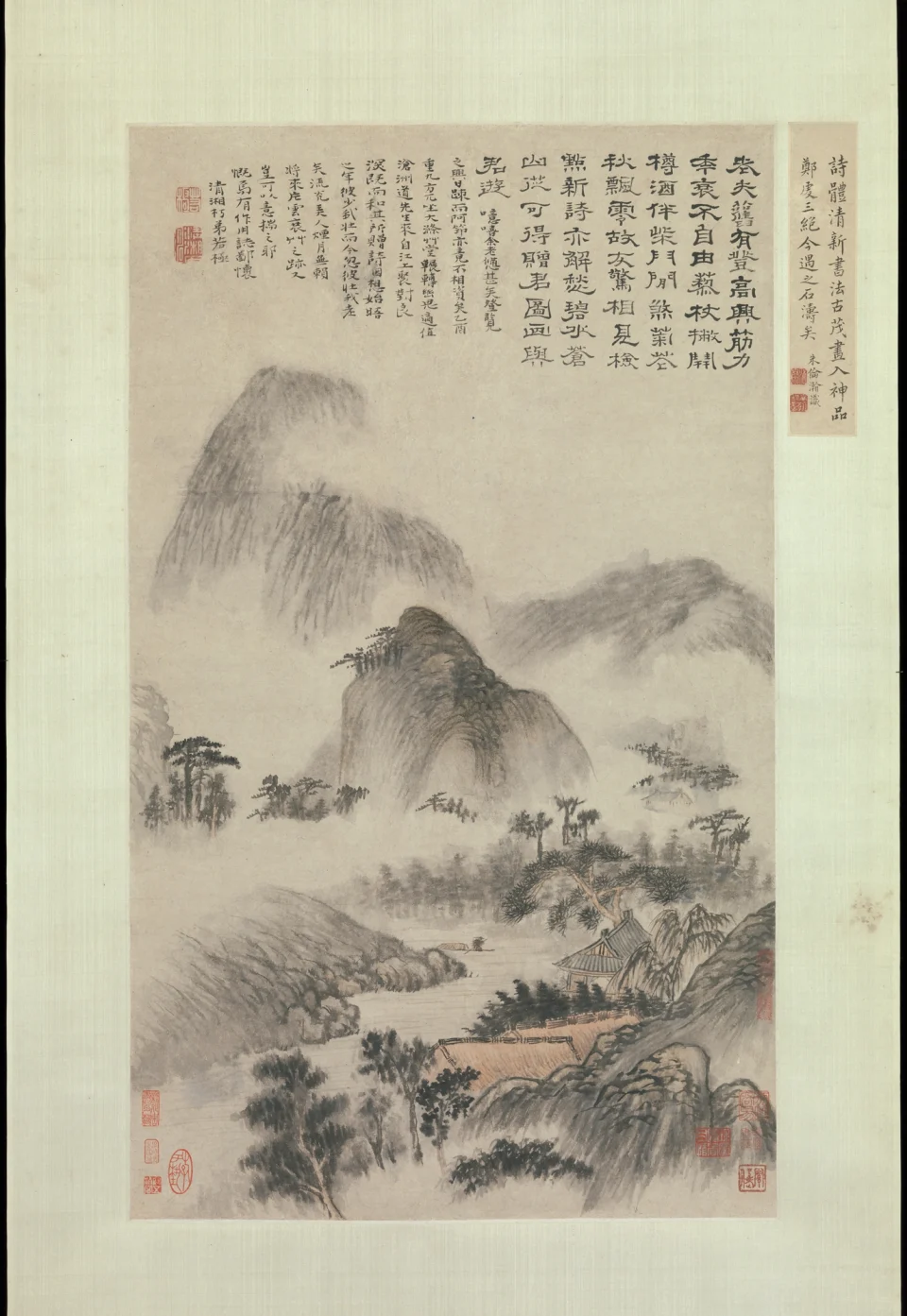
- First, look
- Writing occupies the upper part of the image. Below it, dark and pale mountain forms frame water and small buildings. Compare the scale of the inscription with the boat: text is part of the work, not a caption that can be cut away.
- Then, check the record
- The catalogue ties the painting to a friend’s festival visit and to aging. That information is different from what a landscape alone could tell us. Follow the original record for its fuller interpretation and inscription translation.
- Finally, connect carefully
- Set this receiving of a visitor beside the absent speaker in Wang Wei’s poem. Both make relationships visible, but the people, dates and media differ. The comparison is a reading exercise, not a claim that one work illustrates the other.
What this cannot establishA dated artwork and its catalogue document one artist’s response to the occasion. They are not a survey of Qing households, evidence that everyone climbed, or a portrait of every older person’s experience.
Text, image & translation rightsPublic-domain artwork image supplied by The Met’s Open Access programme under CC0. Resized to WebP without recoloring; the body image preserves the full downloaded composition. The overview uses a visibly labelled landscape detail. The modern catalogue’s English translation is not covered by that image permission and is not reproduced here.
Choose your invitation, then ask one useful question
For a community event: “Is this mainly a walk, a performance, a shared meal or a service activity—and do I need to book?” Check the organizer’s actual date, venue, accessibility and language. A past event photograph or a traditional calendar date is not confirmation of a current programme.
For a family visit: “Would you prefer company, a meal together or help with something?” Agree before bringing food or arranging an outing. Avoid assuming that an expensive gift, a strenuous activity or a particular ritual is necessary to show care.
For remembrance: “Would it be appropriate for me to join, and would you rather I simply observe?” Ask separately before taking or sharing photographs. Accept a refusal without requiring a reason. The most useful outcome of this guide is a clearer conversation with your host, not a performance of expertise.
A useful distinction
A shared date can hold different meanings. A poem, a painting, a contemporary public initiative and a family invitation are different kinds of evidence; none by itself defines how everyone celebrates.
Frequently asked questions
7 common questions
- Is Double Ninth on September 9?
- Not in the Gregorian calendar. The rule is regular lunar month 9, day 9. The HKO examples used here are October 18, 2026 and October 8, 2027; use a year-specific calendar or converter for another year.
- Are Chongyang and Chung Yeung different festivals?
- They are different romanized names used for the same ninth-month occasion. Mandarin-based Chongyang and the Cantonese-based Chung Yeung can lead to different local descriptions; the name alone does not tell you what an invitation includes.
- Must everyone climb a mountain?
- No. Climbing is a documented association, not an obligation for every participant. Ask about the actual gathering and people’s preferences. Shitao’s 1705 painting is a particularly useful example of a festival response focused on a visit and aging, rather than a compulsory climb.
- Is it a celebration of older people or a remembrance day?
- Both contexts appear, depending on place and community. The contemporary mainland appeal cited here emphasizes older people, while the Hong Kong government account includes visits to ancestors’ graves and outings. Ask the host which context matters; do not use one example to overrule another.
- Do the flowers or foods guarantee health or long life?
- No. Longevity and protection are cultural associations or wishes, not evidence of medical effects. This guide does not recommend plants, drinks or preparations. Ask about any food’s ingredients and let people decline without making it a test of respect.
- Is the poem’s English text an established translation?
- No. It is an AI-assisted working translation made for this guide and clearly labelled pending human language review. The ancient Chinese text comes from the linked Education Bureau reference version. No modern English translator’s version or the museum’s inscription translation has been copied.
- Does the traditional date confirm a holiday or public event?
- No. A traditional date, an official holiday notice and an organizer’s schedule are separate information. Check current local official and venue notices for practical arrangements; this guide does not certify closures, ticket availability or opening times.
Sources & further reading
- Gregorian–Lunar Conversion Table, 2026Hong Kong ObservatoryAccessed Find an archived copy
- Gregorian–Lunar Conversion Table, 2027Hong Kong ObservatoryAccessed Find an archived copy
- Explainer: The evolution of China’s Double Ninth Festival (October 11, 2024)Xi’an Jiaotong-Liverpool UniversityAccessed Find an archived copy
- Landscape Painted on the Double Ninth Festival: Shitao, dated 1705, 1981.285.13The Metropolitan Museum of ArtAccessed Find an archived copy
- Open Access at The Met: image and basic-data policyThe Metropolitan Museum of ArtAccessed Find an archived copy
- 九月九日憶山東兄弟: Chinese reference text (PDF)Hong Kong Education Bureau · GovernmentAccessed Find an archived copy
- Selected Poems by Wang Wei: author introduction (PDF; not the translation used here)Columbia University · Asia for EducatorsAccessed Find an archived copy
- Chung Yeung Festival: Hong Kong cultural-location descriptionHong Kong Government · Film Promotion and Facilitation SectionAccessed Find an archived copy
- 2026 national Respect for Older Persons Month appeal (published October 5, 2026)Hunan Provincial Department of Civil Affairs · GovernmentAccessed Find an archived copy