
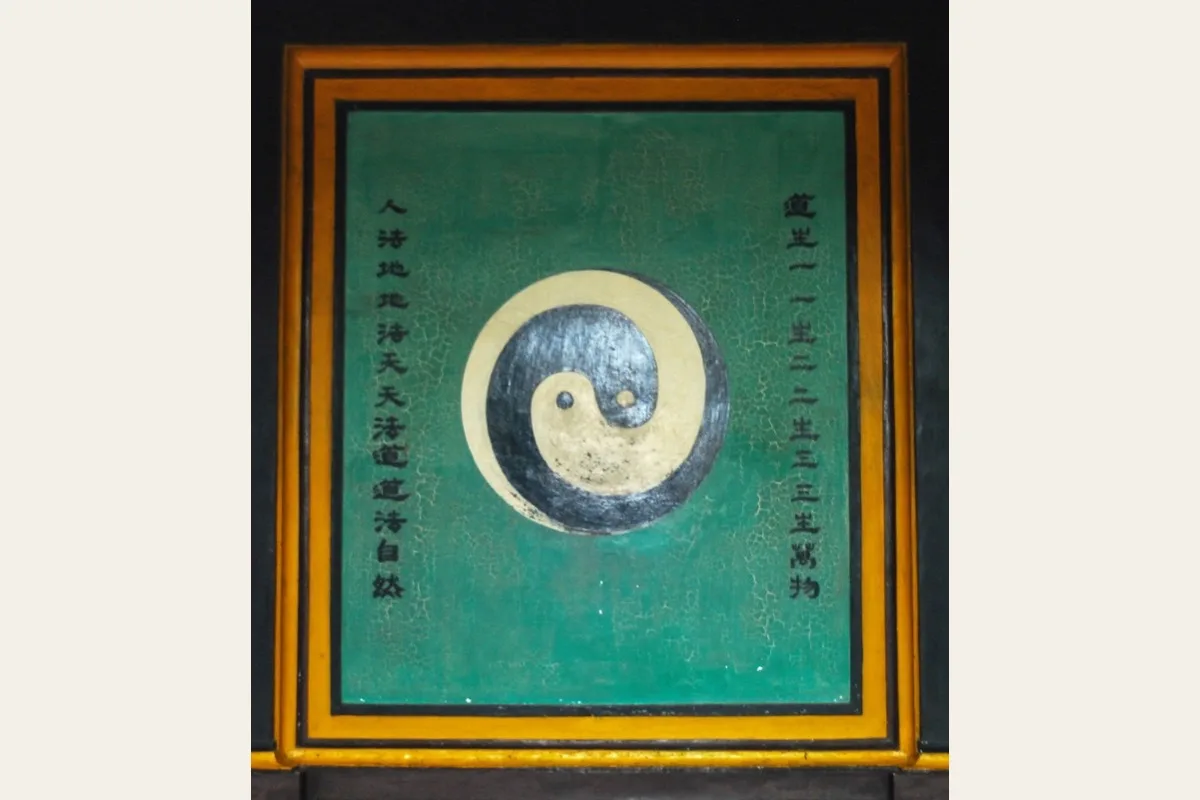
Begin with sun and shade
Early uses of the terms include the shaded and sunlit sides of a landscape. That is a helpful starting point: the same hillside contains both, and its conditions change. Later thinkers used the pair to discuss movement and rest, seasons, and the workings of the world.
The Internet Encyclopedia of Philosophy emphasizes interaction and dynamic harmony across many interpretations. “Balance” here need not mean keeping two identical quantities permanently still.
The idea is larger than its emblem
Yin-yang thinking appears across several Chinese intellectual traditions, including Confucian and Daoist thought. It is not the exclusive property of one school. Diagrams developed as ways to explain cosmological relationships; the familiar emblem is one visual expression within that larger history.
Reading the symbol as a battle between a good half and an evil half misses the relationship it is meant to explore. Neither side makes sense entirely on its own.
Context matters, including gender
Historical writers often linked yin with female and yang with male, but those associations were not simply biological definitions. The same person could be described differently in different relationships. At the same time, yin-yang arguments were sometimes used to justify unequal social roles; explaining complementarity should not erase that history.
For a contemporary reader, the useful question is what relationship a writer is describing and what assumptions they bring to it. This is a philosophical vocabulary to examine, not a test that fixes a person’s identity or determines their future.
A useful distinction
Yin does not mean evil, and yang does not mean good. The pair also does not justify assigning everyone a permanent personality or social role.
Sources & further reading
- Yinyang (Yin-yang)Internet Encyclopedia of PhilosophyAccessed Find an archived copy
- Gender in Chinese PhilosophyInternet Encyclopedia of PhilosophyAccessed Find an archived copy