
Ruyi: Symbol and Objects
如意 rúyì
Ruyi can name a wish and a scepter. Compare two museum objects before assigning one fixed meaning to every curved motif.
Sources checked 28 October 2026 · Specialist review of the original four guides reported by the site owner; newer notes are identified below
Traditional interpretation
A wish in a name
The Smithsonian explains ruyi as “as you wish” and describes its F1937.45 scepter as expressing good wishes. This is a traditional interpretation recorded for a specific object, not a promise that a wish will come true.
Historical evidence
One scepter, different materials
The Met dates its cloisonné-enamel and gilt-bronze ruyi scepter to the 18th–19th century. The Smithsonian’s example uses gold, turquoise and silk and is associated with the Qianlong reign.
Source: The Metropolitan Museum of Art ↗ · Smithsonian National Museum of Asian Art ↗
Historical evidence
Read the surrounding motifs
The Smithsonian records turquoise bats and peaches on the head of its scepter and relates them to good fortune and immortality in Chinese lore. It also says provenance research remains underway.
Modern commercial terminology
A modern design needs context
A contemporary ornament may borrow a ruyi-like outline or name. Check the maker’s description and the full object rather than assuming a particular historical age, material or meaning from a shape.
Source: Smithsonian National Museum of Asian Art ↗ · The Metropolitan Museum of Art ↗
What this reference cannot tell you
These examples document particular objects and interpretations. They do not establish the earliest origin or a universal reading of every design.
Common questions
New comparison notes: source-checked; independent specialist review pending.
Can ruyi appear in writing rather than as a scepter?
Yes. On the Met’s eighteenth-century bowl 24.80.400, ruyi appears in a longer phrase interpreted as a birthday wish. This object is painted enamel on copper alloy, not a jade scepter. Read the whole inscription and the particular catalogue record; the same word does not make every object the same type, material or date.
Source: The Metropolitan Museum of Art ↗
What does ruyi mean?
Ruyi is a Chinese term expressing a wish along the lines of “as you wish” and can also name a scepter. The Smithsonian applies this interpretation to one documented Qing-dynasty object; it does not make every modern ornament a historical scepter.
Are all ruyi objects made of jade?
No. The Met records a cloisonné-enamel and gilt-bronze scepter, while the Smithsonian records an example made with gold, turquoise and silk. Materials and decorative motifs must be checked for the particular object.
Source: The Metropolitan Museum of Art ↗ · Smithsonian National Museum of Asian Art ↗
Objects in context
Use the collection records to inspect dates, material and the limits of each attribution.
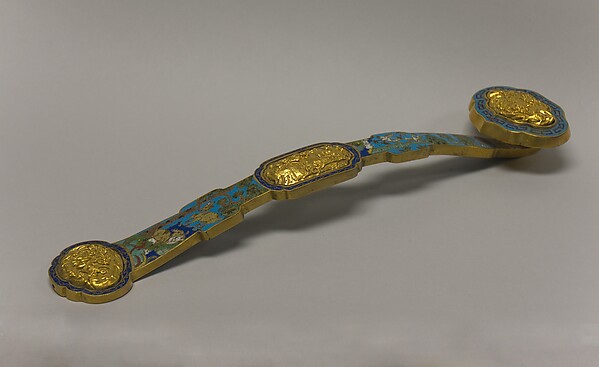
如意 rúyì
Ruyi Scepter
A Chinese ruyi scepter in cloisonné enamel and gilt bronze.
- Date
- 18th–19th century
- Material
- Cloisonné enamel with gilt-bronze medallions
- Collection
- The Metropolitan Museum of Art · 29.110.45
- Place
- China
A dated scepter is not proof of the origin or universal meaning of every ruyi-shaped design.
View the museum record如意 rúyì
Ruyi sceptre
A scepter with turquoise bats and peaches, recorded as a gift to the Qianlong emperor.
- Date
- Qianlong reign, 1736–1796; presented in 1783
- Material
- Gold, turquoise, silk
- Collection
- Smithsonian National Museum of Asian Art · F1937.45
- Place
- China
Provenance research is underway. The website states usage conditions apply to the image; no image is reproduced here.
View the museum recordSources & further reading
- Ruyi sceptre, F1937.45 — Smithsonian National Museum of Asian Art
- Ruyi Scepter, 29.110.45 — The Metropolitan Museum of Art
- Bowl with auspicious emblems (one of a pair) — The Metropolitan Museum of Art
Manage the same analytics choice used across OrientLore.